Categories
Business Hippie Way

Find Your Spot

In a world where change is happening so fast it feels impossible to catch up, many of us are left wondering: How do we keep up, and where do we truly belong?

At the Business Hippie Club, we believe the answer lies in going back to basics, getting real with ourselves.

Authenticity isn’t just a nice word for Instagram captions; it’s the foundation for living a life that matters, both to you and to the people around you. It’s about finding your true rhythm and letting it flow outward to inspire and create meaningful change. (our inside out principle)

Let’s dive into how embracing your authentic self can help you not only find your place in society but also transform it. Here’s the deal: this is all about you being you and making it count.

Why being real matters

More and more people are struggling to feel like they truly belong in today’s fast-changing world. Traditional structures like religion, long a source of belonging, are fading. According to a 2023 Gallup survey, only 39% of people in Western countries report actively participating in any form of organized religion. That’s a big drop compared to 20 years ago. Combine that with the loneliness fueled by constant screen time and online interactions, and you’ve got a recipe for feeling lost.

The good news

But here’s the good news: when old systems crumble, we get to create something new. This is your chance to fill that void with something real, something you. When you focus on what truly matters to you, you move beyond just getting by – you actively create a world where genuine connections thrive.

Start within, change the world

The Business Hippie Way is simple: start within. When you align your inner values with what you do in the world, everything clicks. Think of it as a mirror, when you reflect authenticity, it comes back to you tenfold. This is how:

  1. Get real with yourself Grab a journal or find a quiet spot. Ask yourself: What makes me come alive? What’s one thing I’d fight for, no matter what? These answers are your compass.
  2. Live your values It’s not enough to know your values; you’ve got to live them. Start with something manageable. If building connections excites you, try hosting a small meetup with like-minded people. If fairness drives you, take steps to champion it in your workplace – whether through conversations, initiatives, or simply setting an example.
  3. Create a ripple effect Remember: your authenticity inspires others. When you’re unapologetically yourself, you give others permission to do the same. That’s how movements start – one bold action at a time.

Find your people, make your space

Let’s get one thing straight: finding your place doesn’t mean squeezing into some predefined box. It’s about creating a space where you can show up fully. Here’s how:

  1. Find your tribe Look for people who get you. Whether it’s a local activist group, a co-working space, or even an online forum, connection starts when you share your truth.
  2. Lead by example Don’t see your kind of space? Create it. Organize a workshop, host a discussion, or even throw a dinner party with purpose-driven conversations. Your vibe will attract your tribe.
  3. Step back and zoom-out How does your personal journey connect to what’s happening in the world? Maybe your passion for sustainability fits into a global shift toward green economies, or your storytelling skills can help rebuild social trust.

Why authenticity resonates

Think about the people who’ve inspired you the most. Odds are, they weren’t trying to be anyone else. That’s the magic of authenticity. It’s not perfect, it’s raw, honest, and sometimes a little messy. But it’s real, and that’s what people connect with.

When you live authentically, you create ripples that extend beyond yourself. You’re not just improving your life; you’re shaping a world where others feel empowered to do the same. That’s how communities grow. That’s how societies evolve.

Let’s get real together

Here’s the deal: the journey to authenticity isn’t always easy, but it’s worth it. It starts with small steps; a conversation, a bold decision, or even just showing up as yourself in a world that’s constantly telling you to be something or someone else.

Rethink, redesign and rebuild

At the Business Hippie Club, we’re here to walk this path with you. Together, we can rethink, redesign, and rebuild not only (y)our ideal world but also the communities and systems we’re part of. Because when you align who you are with what you do, the world becomes a better place – as simple as that.

Ready to find your place and make an impact? Let’s start the journey – the Business Hippie way and let’s talk!

Categories
Business Hippie Way

work-life balance is about energy, not time

We all chase work-life balance, believing if we just worked faster or scheduled smarter, we’d finally find harmony. But here’s the truth: balance isn’t about managing time – it’s about aligning your energy with your values.

When we focus on energy, we unlock a deeper level of fulfillment. As a leader, this isn’t just a personal practice; it’s the foundation of conscious leadership, which is about creating environments where everyone thrives – not just survives.

Why balance feels so hard today

In a world that glorifies “the grind,” balance often feels like a pipe dream. Leaders face constant demands, juggling business growth, team management, and personal lives. It’s no wonder 76% of professionals report feeling burnt out at least sometimes (Gallup, 2023).

But here’s the twist: it’s not just about workloads. It’s about whether those workloads align with your core values. When you spend time on things that feel meaningless or misaligned, it drains your energy faster than any 12-hour day.

Conscious leaders understand this. They don’t just chase goals – they question whether those goals resonate with their principles.

How energy and values lead the way

Let’s rethink balance, not as a rigid 50/50 split between work and life, but as a flowing rhythm where your energy and values guide your actions.

Here’s how to bring this idea to life:

  1. Lead with your values
    Start by identifying what truly matters to you. Is it creativity? Connection? Impact? Conscious leaders use their values as a compass, making decisions that feel right – not just strategic.
    • Example: A leader whose value is “growth through collaboration” might prioritize mentoring a team member over attending a networking event.
  2. Design work around energy peaks
    Everyone has natural highs and lows. Maybe you’re sharpest in the morning or full of ideas after a workout. Use this rhythm to tackle tasks that align with your values.
    • Aligning your energy to high-priority, values-driven tasks doesn’t just boost productivity—it fuels purpose.
  3. Set intentional boundaries
    Leadership is about serving others, but that doesn’t mean sacrificing yourself. Conscious leaders know that protecting their energy (and teaching their teams to do the same) is a powerful way to lead.
    • Think of boundaries not as walls, but as bridges between what’s essential and what’s unnecessary.

The power of alignment

As leaders, we’re more than task managers; we’re culture creators. If we model energy management and values alignment, our teams will follow suit.

For example:

  • When you honor your downtime, your team feels empowered to do the same.
  • When you bring purpose into meetings – asking “How does this align with what we believe?”- you foster deeper engagement and motivation.

A 2023 study by McKinsey found that teams led by values-driven leaders were 30% more likely to feel engaged and 50% less likely to report burnout. When people see that their work aligns with a bigger “why,” it transforms how they show up.

What happens when we get it right?

Imagine an organization where:

  • Decisions are made with purpose, not just urgency.
  • Team members feel energized and valued because they’re working toward something meaningful.
  • Leaders are modeling not just success, but sustainability.

This isn’t just about feeling good – it’s about thriving in a way that drives innovation, creativity, and long-term success.

Your next step

To start shifting from hustle to harmony, ask yourself:

  1. What drains my energy the most?
  2. What tasks or projects align most closely with my core values?
  3. How can I, as a leader, create a culture where energy management is as important as hitting targets?

When you focus on energy and values, balance stops feeling like a juggling act and starts feeling like a natural flow. And as a conscious leader, that flow is what empowers you – and your team – to thrive.

Peace, Love & Happiness!

Hans van de Rakt

Business Hippie Club

http://www.businesshippie.club

Categories
Business Hippie Way

aligning purpose with profit

In today’s business world, something beautiful is happening: people are waking up to the fact that purpose and profit don’t have to be at odds – they can fuel each other. This isn’t just a trend; it’s a movement toward creating businesses that thrive by doing good.

But let’s be real – it’s not always easy to get there. Leaders feel pulled in so many directions: customers who expect real action on sustainability, employees who want to work for something meaningful, and investors who want to see long-term value (without losing sight of the bottom line). At the same time, there’s a need to grow, stay competitive, and manage the everyday pressures of running a business.

Here’s the thing: when you align your purpose with your business strategy, magic happens. It’s not just about making promises; it’s about making a real, tangible impact – and that’s where I come in.

Why purpose matters more than ever

The world is asking businesses to show up differently. It’s not enough to turn a profit anymore; people want to know what you stand for, how you operate, and what kind of future you’re building. Businesses that embrace this shift are seeing the benefits firsthand—like stronger relationships with their customers, more engaged employees, and trust from values-driven investors.

Think about it: when you weave purpose into everything you do, from how you treat your people to the way you design your products, you’re not just ticking boxes for ESG (Environmental, Social, Governance) or CSR (Corporate Social Responsibility). You’re creating a business that people believe in—and want to support.

And the results speak for themselves. Studies show businesses that prioritize purpose see 40% higher long-term returns and attract 23% more loyal employees. Purpose isn’t a side project; it’s the foundation for thriving in today’s world.

The Inside-Out approach: it starts with you

At The Business Hippie Club, we believe all transformation starts from within—what we call our Inside-Out Approach. When leaders align their personal values with their business, that ripple effect changes everything. Here’s how it works:

  1. Get Real with Your Purpose This isn’t about coming up with a fancy mission statement; it’s about digging deep into what matters to you as a leader. Why does your business exist beyond profit? What kind of impact do you want to have in the world? Together, we uncover your purpose and align it with your business goals.
  2. Align Strategy with Impact Once your purpose is clear, it’s time to embed it into your business strategy. We’ll look at how your decisions can create real value—not just for your bottom line but for your employees, customers, and the world around you. Whether it’s integrating ESG principles into your operations or creating initiatives that make a difference, this is where purpose meets action.
  3. Make Waves with Meaningful Impact Purpose comes alive when it’s shared. From launching sustainable products to building community partnerships, the outward impact of your business reflects its soul. This isn’t about ticking boxes; it’s about making waves in a way that’s authentic to you.

Why businesses like yours are the future

Let’s face it—the old way of doing business doesn’t work anymore. People are craving connection, authenticity, and trust. In our article, A Social Economy Based on Human Values, we explored how businesses can become a force for good by operating with integrity and putting people first.

At the same time, The Rise of Societal Refugees showed us how disconnected people feel from organizations that lack purpose. This is your chance to be the kind of business people want to rally behind—a business that gives them hope for a better world.

Let’s make it happen

Here’s the deal: aligning purpose with profit isn’t just possible—it’s necessary. It’s the way forward for businesses that want to thrive while making a real difference.

I’m here to help you find that sweet spot where your values meet your strategy, creating a business that’s not just successful but deeply impactful. Whether it’s transforming your leadership, embedding purpose into your operations, or creating initiatives that make waves in your community, we’ll work together to bring your vision to life.

Are you ready to turn your business into a force for good? Let’s connect and start building something meaningful – together.

Peace, Love & Happiness!

Categories
Business Hippie Way

a social economy based on human values

the Business Hippie Way

The time has come to rethink our economic systems. As discussed in The Decline of Religion: A New Search for Meaning and The Rise of Societal Refugees, people are seeking more than just financial stability—they’re looking for purpose, meaning, and connection. Our current profit-driven economy often neglects the deeper needs of society and the environment. To address this, we must shift towards a social economy that is built on human values, where profit serves people, purpose, and the planet.

Shift to different values

We’re moving away from a production era and profit-oriented economy, where the shareholder value system has long dominated. This outdated model neglects the negative impact it has on climate and society, focusing narrowly on financial returns. The more recently adopted shared value system tries to balance business priorities with social responsibility by “doing good” to offset negative impacts, but it still places profit first.

What we truly need now is a social economic system where business does not hinder, but actively accelerates the transition from profit-driven goals to purpose-oriented initiatives. This shift calls for an economy where every business decision aligns with social and environmental values, driving meaningful change.

The foundation of a human-centered economy

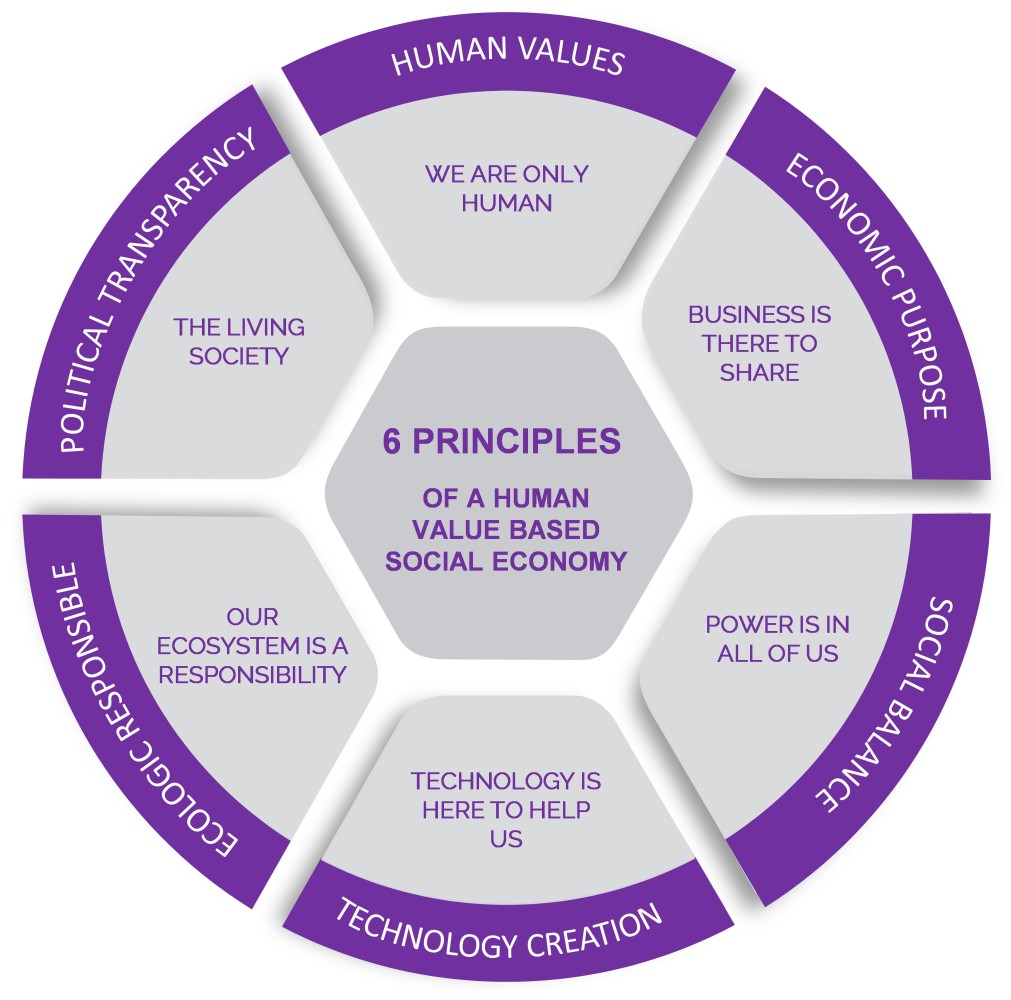
A social economy based on human values doesn’t simply modify existing practices; it reimagines the economy’s purpose. Instead of prioritizing financial gain above all else, this approach seeks to balance economic activity with social and environmental responsibility. At its core are six guiding principles that reflect the Business Hippie Club’s philosophy:

  1. Human – Values We are only human, and intangibles like respect and trust are what truly drive business value. An economy built on human values ensures that businesses prioritize people over profits, recognizing that relationships and well-being are essential components of success.
  2. Economic – Purpose Business should be about more than just generating profit; it should share a purpose that benefits society. When companies place purpose at the center of their strategy, they can create long-term value that goes beyond financial returns.
  3. Social – Balance Power lies within all of us and achieving balance means creating cultures where talent thrives. A social economy places cultural transformation and individual empowerment at the forefront, recognizing that people are the most valuable resource.
  4. Technologic – Co-Creation Technology is here to help us, not control us. Embracing co-creation in technological development enables us to leverage digital tools for societal good. This collaborative approach ensures that technological advancements are used to address shared challenges.
  5. Ecologic – Responsibility Our ecosystem is our responsibility—it’s not someone else’s problem to solve. Businesses must adopt practices that prioritize environmental sustainability and acknowledge that our actions today will impact future generations.
  6. Political – Transparency A living society is one in which everyone contributes, and transparency is key to a fair political system. Businesses have a role to play in advocating for transparency and integrity in governance, ensuring that economic policies support the well-being of all citizens.
6 macro-economic principles

Why it matters now

The urgency to shift towards a value-driven economy has never been clearer. With increasing social inequalities, environmental crises, and a disconnect from traditional institutions, our current economic model falls short. Recent studies indicate that companies with strong commitments to social and environmental goals outperform their peers financially, with 14% higher productivity and increased employee satisfaction.

This isn’t just a trend. It’s a response to the shifting expectations of society, where 88% of consumers prefer brands that support sustainability and ethical practices. We need an economy where profit and purpose are not competing priorities but complementary forces driving us forward.

Collaborating across stakeholders for real progress

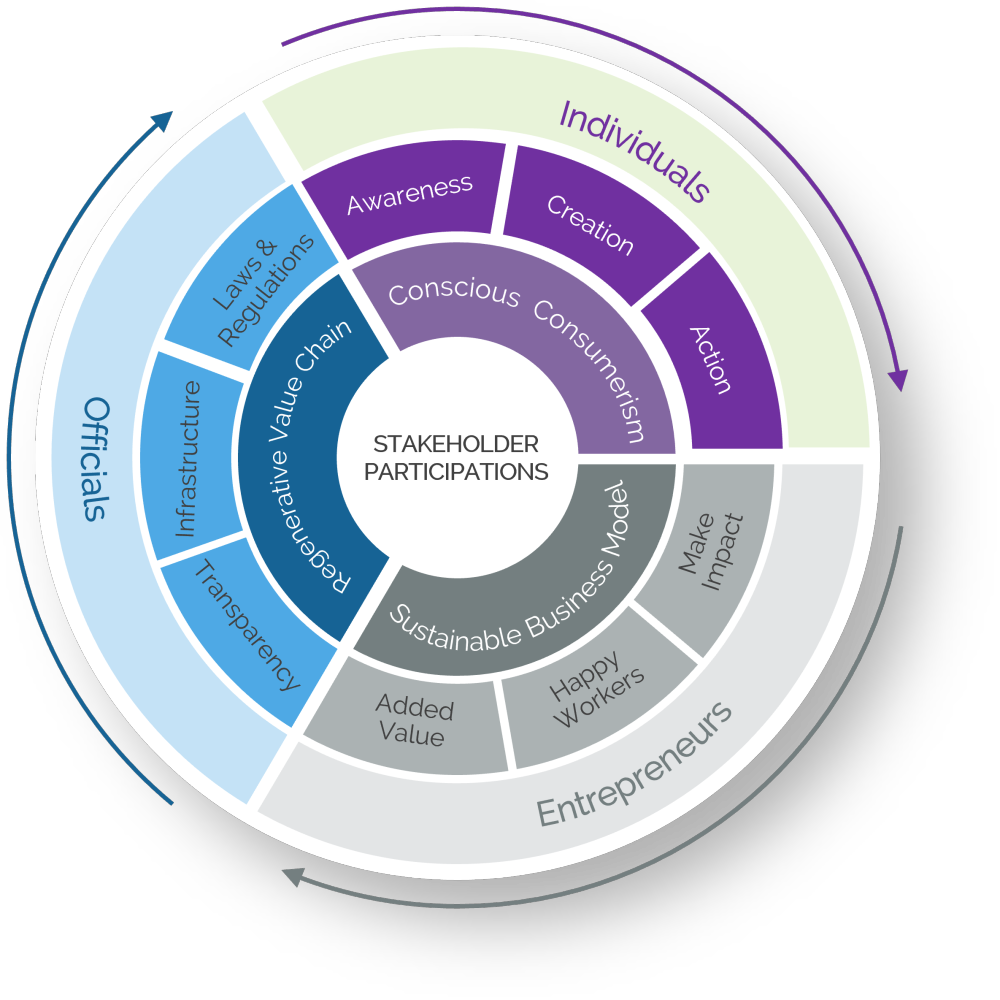
Our society consists of three primary stakeholders: Individuals, Entrepreneurs, and (government) Officials. Each has unique goals and methods, but they don’t operate in isolation. These stakeholders influence one another, and true progress requires their collaboration. To achieve meaningful change, we must align our efforts, look beyond our individual interests, and combine our strengths. The urgency to act is shared, and the potential impact is multiplied when we work together.

3 main stakeholders and representations for collaboration

The path to a value-based economy

To truly integrate human values into the economy, we must go beyond surface-level gestures and take actions that address systemic issues. Here’s how we can bring this vision to life:

  1. Redefine Success Beyond Profits The definition of success needs to evolve to include social impact, environmental stewardship, and employee well-being. Companies like Patagonia and Ben & Jerry’s demonstrate that purpose-driven models can generate both profit and positive societal change.
  2. Embrace Co-Creation and Open Innovation Collaboration across industries and communities can yield sustainable solutions to shared challenges. The open-source software movement shows how co-creation can revolutionize industries by sharing resources and knowledge. Applying this approach to social and environmental issues can drive far-reaching change.
  3. Conscious Decision-Making in Every Aspect of Business Every choice made by businesses—from sourcing materials to setting investment priorities—should reflect a commitment to human values. Conscious decision-making ensures that business growth supports society and the environment, rather than exploiting them.
  4. Invest in Community Engagement and Local Partnerships Local communities are essential to sustainable development. When businesses invest in local economies through responsible sourcing and hiring, they not only support community growth but also create resilient supply chains that reduce the impact of global disruptions.
  5. Push for Systemic Change Through Policy Advocacy Businesses must advocate for policies that promote ethical practices, such as fair wages, environmental protections, and social justice. A transparent political system where everyone’s voice is heard is crucial for creating an economy that serves the common good.

Leading the transition to a new economic era

Visionary leaders and purpose-driven companies can spearhead the shift towards a social economy. By embracing the Business Hippie Club’s guiding principles—Values, Purpose, Balance, Co-Creation, Responsibility, and Transparency—they can set new standards for what it means to thrive. It’s about redefining success to include the well-being of people and the planet, and inspiring others to join the movement.

The time for change is now

The world is facing unprecedented challenges, and the need for an economy built on human values has never been more pressing. By prioritizing courage, transparency, integrity, innovation, collaboration, and balance, we can create a social economy that not only generates profit but also enriches lives and protects our planet.

Let’s not settle for outdated models that serve only a select few. Instead, let’s build an economy where business drives positive change and human values shape our future.

Together, we can create (y)our ideal world—The Business Hippie Way, where profit and purpose go hand in hand, and society thrives as a whole.

Ready to Make a Real Impact?

If you’re a leader, entrepreneur, or company ready to align your business with deeper purpose, I can help. At the Business Hippie Club, we bring visionary strategies, social innovation, and a values-driven approach to transform your business into a force for good. Let’s work together to redefine success, drive meaningful change, and build an economy that serves everyone.

Hire me to start your journey towards a more purposeful and impactful business. Contact me and let’s co-create (y)our ideal world.

Peace, Love & Happiness!

Hans van de Rakt

Categories
Business Hippie Way

why are you in business?

Creating a social role in business organizations

In today’s world, businesses are more than just profit-driven entities, they’re becoming second homes for employees. Where culture shapes well-being, mental health, and identity. The question Why are you in business? should encompass not only financial success but how your company nurtures employees and contributes to societal well-being.

Business as a Social Force

As we discussed in The Decline of Religion: A New Search for Meaning and The Rise of Societal Refugees, traditional institutions like religion are losing their hold on people’s sense of purpose. More individuals are now seeking meaning in new places, including the workplace. As people feel disconnected from societal structures, businesses have a growing responsibility to step in and provide that sense of purpose and belonging.

By creating purpose-driven cultures, companies can become platforms for connection and growth. As such filling a gap that religion and other traditional systems once occupied. This reflects the growing trend of individuals feeling like “societal refugees,” searching for new spaces to find meaning, whether in work, communities, or alternative frameworks for life.

Examples of purpose-driven businesses

Salesforce and Patagonia are great examples of companies embracing purpose alongside profit. Salesforce’s “Ohana” culture has led to a 25% productivity boost by treating employees like family. Patagonia’s commitment to environmental activism has not only driven $1 billion in revenue but also cemented their role as a leader in social and environmental change.

Trends and data supporting this shift

The trend toward purpose-driven businesses is backed by hard data. Gallup’s study found that companies with highly engaged employees see 21% greater profitability. Poor mental health, according to the World Health Organization, costs the global economy $1 trillion annually in lost productivity. Organizations prioritizing mental health and flexibility have reduced burnout by 40%, demonstrating the value of a strong, supportive workplace culture.

Aligning purpose with profit

When businesses position themselves as sources of purpose, they attract not only loyal employees but also customers who resonate with their values. By answering Why are you in business? companies can redefine their role as platforms for positive change, fostering both social good and profitability.

Practical steps for aligning purpose with profit:

  1. Define a purpose beyond profit: Identify how your business can improve the well-being of employees and society.
  2. Create a strong, supportive culture: Foster a culture that prioritizes mental health, flexibility, and personal growth.
  3. Engage employees in shared values: Build a sense of community where everyone works toward a shared mission.
  4. Adapt to trends: Embrace changes like hybrid work models and mental health programs to meet modern expectations and improve well-being.

The Business Hippie way: aligning purpose and profit

At the Business Hippie Club, we believe businesses should serve as platforms for both personal and societal transformation. The question Why are you in business? should focus on creating a meaningful impact on people’s lives, beyond just financial gain. By aligning purpose with profit, companies can foster an environment where employees thrive, customers feel connected, and society benefits.

Let’s work together to create (y)our ideal world, where purpose and profit come together to drive positive change and build a brighter future for everyone.

Plan a talk to discuss this, in my online agenda: www.calendly.com/hansvanderakt

Peace, Love & Happiness!

Categories
Business Hippie Way

The decline of religion: a new search for meaning

As traditional religious structures weaken, particularly in Western societies, people are increasingly searching for new systems of belief and identity. This trend is accelerating the phenomenon of “societal refugees” those who feel disconnected from societal norms, including religious institutions, work systems, and education. (See our previous article) The erosion of these traditional anchors, along with increasing secularism, has left a growing number of people without a clear framework for understanding their place in the world.

Decline of religion

Recent data from the Pew Research Center shows that as of 2023, 28% of U.S. adults identify as religiously unaffiliated—often referred to as “nones” (atheist, agnostic, or nothing in particular). This figure has remained relatively stable in the past few years after years of steady growth, peaking at 31% in 2022. In comparison, only 16% of U.S. adults identified as unaffiliated in 2007 This trend is mirrored in Europe, where secularization is even more widespread, particularly in countries like the UK, France, and Scandinavia.

Search for new meaning

While organized religion traditionally provided community, moral guidance, and a sense of purpose, many individuals today seek alternative frameworks for meaning. This shift reflects a larger dissatisfaction with rigid structures and doctrines, leading people to explore spiritual but not religious (SBNR) approaches, emphasizing personal spirituality over institutionalized practices. As religious participation declines, many find themselves searching for purpose and belonging elsewhere, fueling the rise of new social movements focused on personal growth, ethical living, and communal support.

Key reasons behind the decline of religion

Several factors contribute to this phenomenon:

  1. Secularization: Growing reliance on science and rationalism reduces the need for religious explanations.
  2. Disillusionment with Institutions: Scandals and rigid dogma have led to widespread distrust of religious authorities.
  3. Individualism: People are shifting toward personal spiritual practices, crafting their own belief systems outside of organized religion.
  4. Cultural Diversity: Globalization exposes people to a variety of belief systems, encouraging questioning of traditional religious claims.

The rise of societal refugees

The concept of societal refugees aligns with this trend. Individuals who feel displaced from traditional societal structures often seek new forms of community and meaning.

For many societal refugees, work no longer satisfies their deeper needs for connection and purpose. As businesses become increasingly disconnected from ethical and sustainable practices, people are looking for alternative lifestyles that emphasize well-being, community, and social impact, core principles that align with the values of conscious living. See our article

Consequences of the decline of religion

As religious affiliation declines, the implications for society are profound:

  1. Search for Alternative Frameworks: Without the moral and social structure provided by religion, individuals turn to movements like conscious living, environmentalism, and ethical consumerism for guidance.
  2. Increased Focus on Personal Well-Being: As traditional religious beliefs wane, secular alternatives like mindfulness, meditation, and wellness practices fill the void, offering individuals spiritual experiences without religious structures.
  3. Loss of Traditional Community Structures: With the decline of religious institutions, which often serve as community hubs, there is a fragmentation of community life. People are now seeking alternative ways to build relationships and find support, often through social movements or lifestyle practices.
  4. New Ethical and Moral Frameworks: As society shifts away from religious foundations, secular ethics, and humanism take precedence, influencing social and moral decisions. Issues such as environmental sustainability and social justice become focal points for personal identity and community engagement.

This shift presents opportunities for new movements and frameworks to offer individuals purpose, community, and guidance in a world where traditional anchors are eroding.

Data on the rise of conscious lifestyles

The decline in religious affiliation correlates with the rise of movements focused on conscious living, sustainability, and ethical business practices. A study by Deloitte found that 80% of Millennials believe that businesses should have a clear purpose, while 64% of global consumers prefer to support companies that demonstrate social responsibility. This shift in consumer behavior mirrors the desire for more holistic, value-driven lifestyles that provide both financial stability and ethical alignment.

The role of conscious living in the post-religious era

With religion no longer the dominant force shaping morality and community, people are increasingly turning to alternative systems that integrate personal well-being, social impact, and environmental stewardship. This growing desire for purpose-driven lives is evident in the surge of interest in movements like minimalism, mindfulness, and sustainability, all of which provide a sense of control, ethical alignment, and fulfillment that religion once offered.

In this context, the Business Hippie Way represents a potential lifestyle framework that aligns with the conscious living movement. By integrating personal values with professional lives, and emphasizing community, creativity, and conscious leadership, (see our blogposts) it helps individuals find new meaning in a world where traditional religious and social structures are faltering. The Business Hippie Way provides a path for individuals seeking purpose, alignment with their values, and a lifestyle that embraces both ethical business practices and personal well-being.

Peace, Love & Happiness!

Link to the article: the rise of societal refugees

Categories
Business Hippie Way

the rise of societal refugees

In today’s rapidly evolving world, more and more individuals are finding themselves disconnected from the societal structures they once relied on. These individuals, whom we might call “societal refugees,” are not displaced by war or natural disaster but by the invisible forces of societal expectations, economic structures, and cultural norms. They are individuals who, though physically present, feel emotionally, intellectually, or spiritually displaced from a society that seems ill-suited to their values or way of life.

The question arises: how can we create a world that no longer forces people to seek refuge from societal systems but rather encourages them to thrive within inclusive, conscious, and purpose-driven frameworks?

The Making of a Societal Refugee

A societal refugee might be anyone who feels a profound sense of disconnection from mainstream life. These individuals might be:

  • Professionals disillusioned by corporate cultures focused solely on profit, where well-being, purpose, and community take a backseat.
  • Youth who struggle to find a place in rigid educational or job markets that don’t value creativity, diversity, or alternative forms of contribution.
  • Activists or changemakers who reject traditional career paths and societal expectations to pursue lives of purpose, sustainability, and social impact.
  • Elders who feel sidelined in a world that values youth, speed, and constant innovation over wisdom, patience, and experience.

For these people, mainstream societal structures offer little room for growth or fulfillment, leaving them feeling like outsiders or refugees within their own communities. This disillusionment drives them to seek alternative ways of living, working, and relating—often outside of the traditional frameworks they were once part of. Why not encourages them to thrive within inclusive, conscious, and purpose-driven frameworks?

Real-Life Examples

  • The Tiny House Movement: Individuals and families in the U.S. and Europe are increasingly choosing to leave behind traditional homeownership in favor of minimalistic living. The tiny house market was valued at approximately USD 18.83 billion, represents a growing rejection of consumer-driven culture and the housing market. It’s a prime example of how societal refugees are opting out of conventional paths in search of sustainability and simplicity.
  • Digital Nomads and Remote Workers: With the rise of the gig economy, freelancers make up 38% of the U.S. workforce, equating to about 64 million people. Many of these freelancers, often societal refugees, reject traditional office jobs and choose remote work, allowing them to travel, live in alternative communities, or align their careers with personal values like freedom, creativity, and well-being.

The Systemic Problem: Structures Built on Exclusion

Many of today’s societal systems—whether economic, educational, or corporate—are built on outdated models. These models emphasize rigid hierarchies, competition, and efficiency at the cost of human connection, well-being, and creativity. This structure inadvertently excludes those who prioritize purpose over profit, collaboration over competition, and sustainability over short-term gains.

For societal refugees, these systems can feel stifling and even oppressive, leading them to opt out. But as more individuals step away from mainstream society, the cracks in these structures become more visible. A growing movement calls for rethinking and redesigning our systems to be more inclusive, purpose-driven, and holistic. (e.g. the Business Hippie Club)

A New Path Forward: Creating Inclusive Systems for the Future

At the heart of the solution lies a simple but profound idea: we need systems that invite everyone to participate and thrive. Whether in business, education, or communities, the future must be about creating spaces where diverse worldviews, talents, and ways of being are not only accepted but celebrated.

1. Rethinking Work and Business

The rise of conscious businesses, social enterprises, and purpose-driven strategies offers a glimpse of what the future could hold. These models challenge the traditional business paradigm by putting purpose before profit, integrating well-being into organizational culture, and fostering collaboration over competition. Leaders who embrace this shift can create work environments that invite societal refugees to return, thrive, and contribute meaningfully. This is the mission of the business hippie club.

2. Creating Communities of Belonging

A sense of belonging is essential for human well-being, and societal refugees often seek out alternative communities that reflect their values. From eco-villages to co-working spaces that prioritize wellness, people are carving out spaces that reflect a more holistic approach to life. Scaling these models can create broader societal systems that promote inclusivity, shared purpose, and community, fostering a sense of belonging even within larger social frameworks.

3. Designing Inclusive Education Systems

Education must evolve to meet the needs of those who don’t fit into rigid boxes. Alternative education models like experiential learning, self-directed education, and purpose-driven curricula give people the tools to explore their unique potential, emphasizing the development of conscious leaders and changemakers. Example is Big Picture Learning.

4. Embracing Conscious Living

At its core, the societal refugee movement is a call for conscious living—an approach that prioritizes mindfulness, sustainability, social impact, and well-being. By encouraging conscious living as a societal value, we can cultivate more compassionate, inclusive communities where individuals can live authentically and meaningfully, without feeling forced into roles or structures that don’t align with their values. See our blogposts about conscious living

From Societal Refugees to Conscious Contributors

What if we could transform societal refugees into the very people who lead our next wave of innovation and growth? By embracing diversity, creating flexible and inclusive systems, and prioritizing purpose, society can not only accommodate those who feel excluded but benefit immensely from their unique perspectives and talents. These individuals, once on the fringes, have the power to be the changemakers that redefine what it means to be successful, connected, and fulfilled.

As we look to the future, it’s clear that the time has come to build systems that embrace the full range of human experience. The societal refugee is not an outcast but a harbinger of what’s possible when we align our structures with purpose, well-being, and conscious living. Let us create a world where no one needs to seek refuge from society but can find their place and thrive within it.

Consequences of the Rise of Societal Refugees

The rise of societal refugees has profound consequences on multiple levels—social, economic, and even personal. Here are some of the key impacts:

1. Loss of Potential for Innovation and Creativity

When individuals feel marginalized by societal systems, their unique talents, ideas, and potential contributions often go untapped. These societal refugees might be creatives, innovators, or changemakers whose different perspectives could lead to breakthroughs in business, science, and culture. However, when they are sidelined or excluded, society as a whole loses the opportunity to benefit from their insights and innovations.

2. Erosion of Social Cohesion

As more people feel disconnected from mainstream society, there’s a growing sense of fragmentation. Communities become less cohesive, with certain groups choosing to opt out of societal structures entirely. This fragmentation can lead to increased polarization, where different social groups live in silos, disconnected from one another’s experiences, values, and struggles. See our Utopia Challenge

3. Mental Health Challenges

Feeling alienated or disconnected from society can have significant mental health consequences. Societal refugees often experience loneliness, anxiety, or depression as they struggle to find a sense of belonging or purpose. Without supportive systems or communities, the psychological toll can be high, leading to increased mental health crises among individuals who feel marginalized. The Business Hippie Club response: Art & Wellness at the beach project

4. Strain on Economic Systems

Traditional economic systems that prioritize profit and efficiency over purpose and well-being may find themselves struggling to retain talent. Societal refugees may leave corporate environments or traditional workplaces, leading to higher turnover, disengagement, and a loss of productivity. Furthermore, as more people opt for alternative lifestyles, gig economies, or off-grid living, traditional businesses may struggle to attract and retain the next generation of workers. learn about our soci-economic view: a social economy based on human values

5. Increased Demand for Alternative Systems

As more societal refugees reject mainstream societal structures, there’s an increasing demand for alternative systems that prioritize inclusivity, sustainability, and purpose. This might include:

  • New business models, like social enterprises or purpose-driven companies.
  • Alternative education systems that value creativity, mindfulness, and experiential learning.
  • Community-driven solutions that focus on sustainability, shared resources, and cooperative living.

The challenge is that these alternative systems are still in development and may not yet be able to fully support the growing population of societal refugees, leading to an even greater sense of displacement.

6. Cultural Shifts Towards Conscious Living

On a positive note, the rise of societal refugees also drives cultural change. Their dissatisfaction with current systems acts as a catalyst for movements promoting conscious living, sustainability, and purpose-driven initiatives. This cultural shift can lead to innovations in the way businesses operate, how communities are built, and even how governments structure their policies. see our blog posts about conscious living

7. Transformation of Leadership Models

Traditional leadership models, based on hierarchies and competition, are increasingly being challenged by those seeking more empathetic, purpose-driven approaches. Societal refugees are often drawn to leaders who embrace collaboration, emotional intelligence, and holistic well-being, which in turn is pushing businesses and organizations to adopt new leadership styles that reflect these values. Over time, this could result in a fundamental shift in how leadership is defined and practiced across industries. For example, with Patagonia.

8. Political and Social Movements

As societal refugees grow in numbers, they can become a powerful force for political and social change. Their desire for systems that prioritize human dignity, equality, and sustainability may fuel grassroots movements and political campaigns aimed at restructuring societal frameworks. These movements could influence policies on everything from workplace rights and environmental sustainability to education reform and mental health support. like the Fridays For Future organization of Greta Thunberg.

9. Rise in Self-Sustaining Communities

Many societal refugees seek out or create self-sustaining communities that reflect their values, such as eco-villages or co-housing projects. While this can provide a solution for individuals looking to escape mainstream systems, it also has implications for society at large. As more people leave urban environments or traditional workplaces for these alternative communities, there may be significant demographic and economic shifts that affect cities and traditional industries. For example, the Ecovilla in Costa Rica

10. Increased Awareness of Systemic Injustices

The very existence of societal refugees brings to light the systemic injustices that exist within traditional structures. Whether it’s economic inequality, lack of representation, or rigid education systems, the growth of this group puts pressure on existing frameworks to change. It raises awareness about the need for more equitable, inclusive systems that cater to diverse populations rather than just a select few. Like the Occupy Wall Street movement.

Conclusion: A Call for Systemic Change

The rise of societal refugees is both a challenge and an opportunity. The challenge lies in addressing the social, economic, and psychological consequences of having a growing group of individuals who feel disconnected from mainstream society. However, this is also an opportunity to innovate and reshape our societal systems to be more inclusive, purpose-driven, and compassionate.

The future will likely see the integration of alternative systems into the mainstream, with societal refugees playing a key role in driving this evolution. By listening to their needs and experiences, society can develop new frameworks that not only prevent individuals from feeling like refugees but actively help them thrive.

Peace, Love & Happiness!

Happy to hear your feedback or start a discussion!

Categories
Business Hippie Way

values

In a world that moves faster than ever, it’s easy to get swept up in the current, pursuing goals, following trends, and chasing after what others define as success. But when we pause and look within, what we often find is that a meaningful life is rooted in something much deeper: our values. These values, our deeply held beliefs, are what guide us through the noise, helping us make choices that feel true to who we are.

I’ve come to realize that living according to our values is the foundation of conscious living. It’s about being aware of the impact of our actions, staying aligned with our principles, and creating a life that reflects our purpose. Let’s explore how values can shape our lives in ways that bring us clarity, fulfillment, and connection.

What values mean to me

For me, values are more than just abstract ideas. They are the personal compass that points me in the right direction, especially when life feels overwhelming. Values like integrity, compassion, and transparency guide not only my decisions but also how I interact with others and the world around me.

How about you?

Think about the moments in your life that made you feel truly fulfilled or at peace. Chances are, those moments were aligned with your values. Maybe it was helping a friend in need, standing up for something you believe in, or pushing yourself to grow in ways you didn’t think were possible. In those moments, your actions reflected the core of who you are.

Values and conscious living

Conscious living, a lifestyle topic at the Business Hippie Club, is all about being present, aware, and intentional. It’s about living in a way that aligns with your deepest beliefs and creating a positive ripple effect around you. Here’s how I’ve found values play a key role in living consciously:

Values guide our decisions

Life presents us with countless choices every day, from the big decisions like career paths to the smaller ones like how we spend our time. When we’re clear on our values, it’s easier to make decisions that feel right. For instance, if you value sustainability, you might choose to live in a way that reduces your environmental footprint—whether that’s through the products you buy or the way you travel.

I’ve learned that when my decisions are aligned with my values, I feel more confident and at peace, knowing that I’m staying true to myself.

– Values shape our relationships

Our values influence how we treat others and the kind of relationships we form. When we live with compassion and authenticity, we naturally attract people who share similar beliefs. This builds deeper, more meaningful connections. I’ve found that some of the strongest relationships in my life are those where we’ve bonded over shared values like trust, empathy, or growth.

Living in alignment with my values has helped me build relationships that feel genuine and supportive, both personally and professionally.

Values drive personal growth

Conscious living encourages self-reflection. By regularly assessing whether we’re living in line with our values, we create opportunities for growth. I’ve found that when I stray from my values, it serves as a reminder to re-center myself. The process of realignment often leads to valuable lessons and deeper self-awareness.

Growth, for me, is a constant journey, and values are my guideposts along the way.

Values help us create a positive impact

One of the most fulfilling aspects of living consciously is knowing that your actions can make a difference. When we live by values like equality, kindness, or justice, we naturally contribute to a better world. Whether it’s through small, everyday actions or larger contributions, our values become a force for good in the world around us.

Personally, I’ve found joy in knowing that even small actions—like supporting a cause I care about or helping a friend—can create a ripple effect.

Choosing and living your values

Choosing your values is an ongoing process. Sometimes it requires looking within and asking, “What truly matters to me?” Over the years, I’ve come to realize that some of the values I hold dear today weren’t always front of mind. Experiences, challenges, and personal growth have reshaped how I see the world and what I prioritize.

Here are a few steps that helped me consciously choose and live by my values:

  • Reflect on meaningful moments: Think about times when you felt fulfilled or proud of yourself. What values were present in those moments?
  • Look at the people you admire: Who inspires you? What values do they embody that you resonate with?
  • Assess your current life: Are there areas where your actions feel disconnected from your values? What can you change to realign?

Once you’ve identified your values, the key is to actively live them. I remind myself every day that it’s not enough to just know my values—I need to embody them in my actions.

Bringing values into daily life

Living by your values is an ongoing practice. Here are a few ways I try to bring my values into daily (conscious) life:

  1. Make conscious choices: Whether big or small, I try to ensure my decisions reflect what I care about—whether it’s choosing to spend time with family or pursuing a project that aligns with my purpose.
  2. Create a space for reflection: Regularly checking in with myself helps me stay connected to my values. I often journal or meditate on whether my actions are aligned with my beliefs.
  3. Surround yourself with like-minded people: I’ve found that being part of a community of people who share my values helps me stay focused and inspired.
  4. Practice self-compassion: I’m not perfect, and sometimes I stray from my values. But I’ve learned to approach those moments with compassion, knowing that it’s all part of the journey.

Living a life aligned with values

At the end of the day, living according to our values is what makes life meaningful. It’s not always easy, but it’s incredibly rewarding. Values help us navigate challenges, foster deeper connections, and create a sense of purpose. They allow us to live consciously, with integrity and intention.

By choosing and living by our values, we create lives that feel authentic, grounded, and impactful. And ultimately, that’s what makes the journey worthwhile.

Categories
Business Hippie Way

conscious living – let’s do this together

In today’s busy world, it’s easy to feel like we’re just going through the motions. But I’ve realized that, within all the chaos, there’s a chance for us to create real change, starting with how we live our daily lives. That change begins with conscious living.

Conscious living means aligning our daily choices with the values we find important. It’s about being intentional with how we consume, treat others, and contribute to society, and being aware of our footprint on the planet.

At the Business Hippie Club, we see conscious living as a ripple effect, when more individuals adopt this mindset, the collective impact can reshape communities, industries, and the environment. Through mindful choices, we’re not just transforming ourselves; we’re catalyzing real, lasting change in the world.

It starts with awareness

For me, conscious living began with simply paying attention. I started to notice how my actions, big and small, affected the world around me. Every choice, from what I buy to how I treat others, has an impact. If more of us lived with this kind of awareness, we would create a world that’s kinder, more sustainable, and fairer for everyone.

Working together instead of alone

Conscious living shows us how connected we all are. Once we understand that, we stop competing and start helping each other. Whether in business or in our communities, working together makes us stronger. That’s what we do at the Business Hippie Club, we bring people together to make a bigger impact.

Empathy drives change

Empathy, truly understanding and caring about others, is key to conscious living. It makes us want to help those in need and protect the planet. It’s more than just being kind; it’s about making choices that show we care. This leads to business decisions that prioritize people and the planet, initiatives like fair-trade partnerships, social housing projects, and creating communities that are inclusive and compassionate.

Leading by example

I’ve found that the best way to inspire change is by living it. When you lead by example, people take notice and want to do the same and take action. Whether at work, home, or in your community, living consciously creates a ripple effect that inspires others to follow suit.

At the Business Hippie Club, we embody this by leading with action through projects like the Social Housing Boat and the Conscious Travel Collective. These initiatives show how living consciously can drive real solutions to social challenges and unite people with shared values.

Building systems that support change

We can’t do it alone. For conscious living to really make a difference, we need systems that support it, like ethical businesses, fair policies, and communities that lift each other up.

At the Business Hippie Club, we work to create these kinds of systems by connecting purpose-driven entrepreneurs, advocating for conscious leadership, and fostering partnerships that solve social and environmental challenges. This way, we’re not just talking about change, we’re building the structures that make lasting transformation possible.

The power of small actions

Every small action we take adds up. When more of us live consciously, we create a ripple effect that spreads across society. Imagine a world where businesses care about the planet, communities solve problems together, and people make choices that are good for everyone. That’s the world we’re working toward.

Let’s make this change together

Conscious living may start with you, but when we do it together, we can change the world. By living with awareness, empathy, and purpose, we can create a better future for everyone. Join us at the Business Hippie Club, and let’s walk this path toward collective transformation together.

Categories
Business Hippie Way

about minimalism

Juggling personal and professional responsibilities can easily lead to overwhelm. Minimalism offers a path to clarity and purpose by focusing on what truly matters and eliminating distractions.

When I applied minimalism for myself and my business (hippie club) I noticed significant improvements in my decision-making, stress levels, and overall alignment with my values.

Minimalism isn’t about getting rid of everything but making space for what truly aligns with your values. For me, this meant decluttering not just my workspace but also my schedule and commitments, leading to greater clarity and focus in both life and business.

Integrating minimalism into your life

  • Mental and Emotional Well-being: Simplifying your environment and routines reduces stress and enhances clarity. This mental space allows you to make better decisions and be more productive.
  • Simplified Living: Focus on experiences and relationships that bring genuine joy, rather than accumulating material possessions. This approach has inspired me to align my business practices with the same values.
  • Work-Life Balance: By eliminating distractions and setting clear boundaries, you can create a more balanced lifestyle, which is essential for sustaining long-term motivation and success.

Some practical tips

  • Start with Decluttering: Tackle your living space first, then move on to your digital life. Getting rid of what no longer serves you creates room for what truly matters.
  • Practice Mindful Consumption: Be intentional with your purchases. Prioritize quality and meaningful experiences over quantity.
  • Set Boundaries: Learn to say no to things that don’t align with your goals. This frees up time and energy for activities that are truly important.

The impact

Since adopting minimalism, I’ve noticed a reduction in stress and an increase in creativity and meaningful connections. My business became more efficient, and I felt more in control of my life. Minimalism isn’t about living with less; it’s about making space for more—more clarity, more purpose, and more alignment with your values. By integrating minimalism into your life and business, you can create a life that truly reflects your deepest values and makes a lasting impact.

Start today by taking one small step toward a simpler, more intentional life, and watch how it transforms both your business and personal world. It’s not about perfection, but progress, and every small change brings you closer to the life you want to lead.