the Business Hippie Way
The philosophy behind the Business Hippie Club
Question the goal. Redefine progress. Make different decisions.
So what are we actually trying to create here? A good life. Not one that looks good on paper or on a dashboard. One you actually feel – in how your day moves, in what your work asks of you, in whether the place you live supports you or drains you.
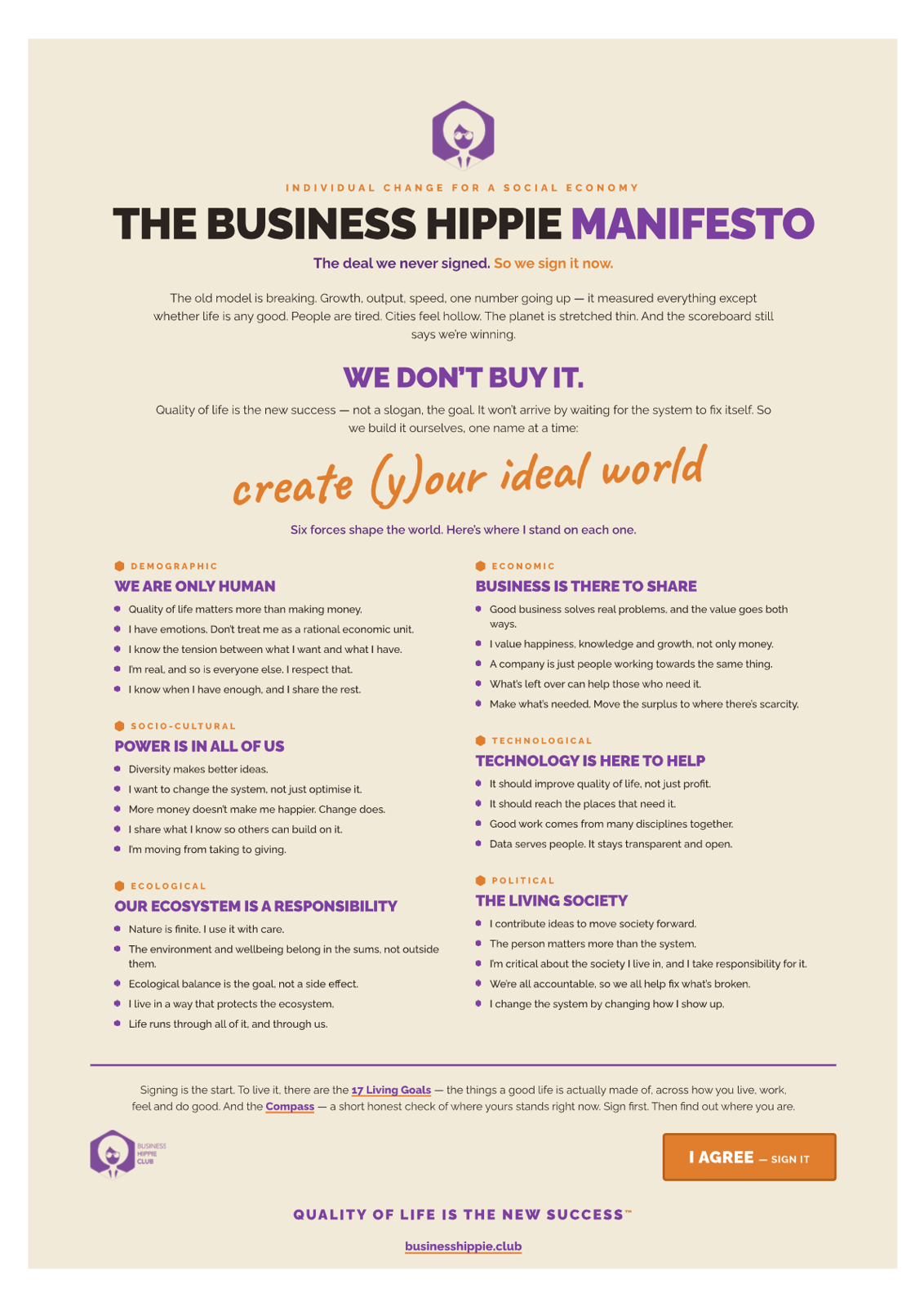
The deal we never signed
There’s a deal underneath modern life, and nobody remembers signing it.
You give your time, your attention, your energy. Back come the numbers – salary, growth, followers, square metres. The numbers go up. Whether your life gets better is your own problem.
It’s a bad deal. Not because the numbers are worthless, but because they were never the point. Somewhere they stopped measuring a good life and started standing in for one.
Seeing the deal is the first step. Renegotiating it is the second.
Seeing the deal is the first step. Renegotiating it is the second.
Surface and reality are not the same
A city can look strong on paper while daily life feels strained. A business can perform well while people quietly lose energy. A life can look impressive while something important is missing.
Between what gets measured and what gets felt sits a blind spot – that’s where quality of life disappears. Not dramatically. Just steadily, while everyone’s looking at the dashboard.
The Business Hippie Way looks into the blind spot.
Between what gets measured and what gets felt sits a blind spot – that’s where quality of life disappears.
Everything is connected
That blind spot doesn’t stay in one place. How you live shapes how you work, how you work shapes how you feel, and the place you’re in shapes what feels possible.
Plenty of old wisdom traditions got there first. The Stoics. The Buddhists. The indigenous elders. Then we forgot it, and built an entire economy on the forgetting. Work split from life. Economy from people. Growth from meaning.
The cost is visible everywhere. Burnout isn’t only a personal failure. Often it’s the system doing exactly what it was built to do.
So the Business Hippie Way starts where they started: life, business and cities are one reality, and they ask to be treated that way.
Burnout isn’t only a personal failure. Often it’s the system doing exactly what it was built to do.
It was chosen, so it can be chosen differently
Somewhere along the way, a version of success got decided for us. Growth. Output. Speed. Keep up or fall behind.
It’s not nature. It’s a convention – and conventions can be questioned.
Look at what we chose to count. GDP rises when a forest is cut down. It says nothing when you finally sleep well, when a neighbourhood holds together, when work gives someone their dignity back. It’s a fine measure of activity and the wrong goal for a society.
We turned a gauge into a destination, then steered everything toward it. We steered by it for decades, and then wondered why everything that really counts felt like it was slipping.
The pace. The pressure. The way cities get built and businesses get run. These were choices, made at a certain time, by certain people, with certain priorities. Quality of life wasn’t one of them.
What was chosen can be chosen differently. That’s not idealism. That’s design.
How those choices were made, era by era: From standard of living to quality of living.
What was chosen can be chosen differently. That’s not idealism. That’s design.
What this is for
Every organisation knows its numbers. Almost none of them know how their people are actually doing.
The goal is to make that second thing normal. Known, asked about, counted alongside the rest.
That takes evidence. Which is what the Quality of Life Study is.
Every organisation knows its numbers. Almost none of them know how their people are actually doing.
Where quality of life lives
Three connected areas.
Your life: how life feels from the inside. Whether the way you live still fits who you are. Whether your work gives direction. Whether your energy is protected. Whether your life still reflects what matters to you.
Your work: a business isn’t separate from life. It shapes rhythm, pressure, trust, meaning, and how people experience their days. It leaves a mark on society too.
Your city: cities are shaped by whether daily life actually works for the people living there. Whether housing is within reach. Whether work creates stability. Whether people still feel connected to the place they live in.
A business isn’t separate from life.
How I read it
I ask the same things everywhere.
The 17 Living Goals are the questions. Seventeen things a life needs, put the same way to a person, a workforce or a city – which is what lets one answer sit next to another. That’s the Compass, an online reflection tool anyone can use.
Then I go and sit down with people. A score shows where the pressure is. A conversation says why. I’ve never found one worth much without the other.
What comes back is a reading in plain language. Not a dashboard. Closer to what a good doctor or a decent journalist does: show up, ask properly, say what you see.
A score shows where the pressure is. A conversation says why.
Comfortable is the problem
Everyone wants a better life. Almost nobody wants the discomfort of going after one.
So we like the post. We share the article. We agree, at a distance, and call that participation. It costs nothing, and nothing is what it changes.
Progress lives in the uncomfortable part. The conversation you’ve been avoiding. The job you keep defending. The thing you’d have to give up.
You already know what yours is. Go back to your roots and do what you have to do.
Progress lives in the uncomfortable part.
The deal you would sign
That’s the philosophy. It only matters when it turns into something you do.
So here’s the other deal, the one you get to read first. It says what a good life asks for, and what you’re willing to put in.