Categories
Business Hippie Way

Quality Of Life Atlas – February


The global human weather

If January felt like careful consolidation, February feels like compression.

There is no crisis language. No loud rupture. Instead, people describe life in conditional terms:
“It’s good – as long as…”
“We’re okay – if this holds…”

The shift across everyday conversation is not panic. It’s calculation – a quiet check of assumptions and reserves.

People are still optimistic about the future, but less confident in the guarantees of stability, opportunity, and upward momentum. What was once described as “possible” is now described as “manageable.”


The four pillars

Live Good

From aspiration to endurance

Housing pressure is no longer debated as an exception. It is accepted as part of urban reality. Access to stable living increasingly depends on income, timing, or network advantage. For many, the focus is not improving lifestyle but preserving it.

  • The shift: living well is less about expansion and more about holding ground.

Work Good

From growth promise to risk calibration

Work remains available in most cities, yet intensity rises. Organisations optimise. Individuals adapt. Security feels increasingly tied to constant performance rather than structural protection.

  • The shift: Ambition remains, but it has become cautious. Continuity feels more valuable than bold risk.

Feel Good

Performance giving way to preservation

Energy management has replaced optimisation. People speak less about thriving and more about avoiding depletion. Mental sustainability becomes a private responsibility rather than a systemic priority.

  • The shift: The language of resilience is present, but it carries fatigue.

Do Good

Contribution narrowed to proximity

Contribution narrows in scope. People prioritise immediate circles over broader systems. Civic intention remains, yet capacity feels finite. Engagement becomes practical rather than expansive.

  • The shift: meaning is still pursued, but at a smaller scale.

City echoes

Based on the cities I visit during the QOL Tour

Lisbon
Opportunity now feels filtered through economic caution. The city is vibrant – yet the cost of living and housing pressure create a quiet recalibration of what a “good life” actually means.

Barcelona
Cultural vibrancy remains strong, but short-term rental stress and community ambivalence have become part of daily discourse. People live well around these constraints.

Paris
Stability persists, but personal margins feel thinner. Day-to-day life runs well, yet energy budgets are tighter.

Ibiza
Beauty and social connectivity remain core strengths. Yet seasonal fragility, workforce dynamics, and housing tension create a layered experience beneath the surface calm.

Bologna
Quality of life feels steady, even reliable. But innovation feels muted and momentum feels internal rather than outward – comfort competes with evolution.

Dubai
Acceleration continues – growth, expansion, performance. But that very speed draws conversation toward endurance and trade-offs between pace and sustainability.


The gap between system and experience

The shift beneath the surface

In February, most cities continue to present stability. Economic indicators remain solid. Investment moves forward. Development plans signal confidence.

By those measures, the system is performing. Yet stability at system level does not automatically translate into stability at individual level.

Housing markets remain strained even in growing economies. Work intensity rises while long-term predictability feels less certain. Cost levels increase faster than the sense of security.

The system measures output and expansion. People measure security and breathing space.

When those two measurements move at different speeds, a gap forms. In January, that gap was observable. In February, it feels more embedded.

Nothing collapses. But more personal effort is required to maintain what used to feel stable. That is where pressure quietly accumulates beneath otherwise successful cities.


Closing reflection

This Atlas does not argue for change; it reflects what people are carrying.

People are adapting. They are not collapsing. But when adaptation becomes the primary stabilizing force of modern cities, the question shifts:

How long can private resilience replace public responsibility?

Quality of life is structural.
It is not measured by a crisis it is experienced in how people navigate the ordinary.


How this Atlas is formed

The Quality of Life Atlas is based on a continuous reading of public human signals. This includes resident and expat discourse, surveys, public reporting, local media, and everyday language across cities.

The focus is not on events, metrics, or individual opinions, but on recurring patterns in how people describe daily life. The Atlas listens for tone, repetition, and quiet tension rather than headlines or trends.
Categories
Business Hippie Way

quality time is not a time problem

It’s a Quality of Life problem.

When people say they want more quality time, it sounds simple.

More evenings without distraction.
More weekends that actually feel like weekends.
More space for what really matters.

The reflex is almost always the same: we open the calendar. Too much work. Too many meetings. Too many commitments. A quantitative diagnosis for a qualitative problem.

But that’s usually not where the real issue lies.

Quality time is not created by free hours. It’s created by available energy.

You can block two hours in your agenda and still not be present. You can go on holiday and still mentally run your company from the beach. You can reduce meetings and still bring tension home like an uninvited guest.

The issue is not time itself. It is how your life is structured.

If your work constantly stretches you beyond your capacity, if responsibility quietly outweighs recovery, if stress has become your normal operating system, then your internal battery is permanently low. In that state, presence becomes fragile. Not because you don’t care, but because there is simply not much left.

This is where quality of life comes in.

Quality of life is structural. It’s about how you live, work, feel, and contribute – and whether those four are in coherence. Whether your daily rhythm supports you, or quietly drains you while you still call it ambition.

When there is coherence, when your work matches your capacity, when your decisions protect your energy instead of trading it away for short-term results, something shifts. You don’t have to manufacture quality time. You have the space for it.

Without that coherence, quality time becomes another improvement project. Something to optimise. Slightly absurd, if we’re honest.

We tend to treat quality time as a scheduling issue. In reality, it’s the result of deeper design choices. Your business model. Your leadership style. Your boundaries. Your definition of success.

If success is built purely on growth and output, quality time will always be under pressure. If success includes sustainability and alignment, quality time becomes a natural consequence.

So perhaps the better question is not how to create more quality time, but whether your current way of working and living actually supports the presence you say you value.

That’s not a time question.

It’s a quality of life question.

And that’s precisely why I keep saying: quality of life is the new success™.

Categories
Business Hippie Way

Quality Of Life Atlas – January

This Atlas does not rank cities, explain causes, or propose solutions. It listens for tone, repetition, and the quiet tension in how people live, work, manage health, and contribute. It remains a partial lens – a “human weather report” that captures what shifts beneath public narratives.


The global human weather

If December reflected calm endurance, January feels tighter.

There is no crisis language. No dramatic complaints. But there is less ease. Conversations have become practical, measured, and stripped of excess. Instead of asking “What’s next?”, people are asking, “Will this hold?” Life is still described as “good,” but almost always with a condition attached. This is not a collapse; it is a careful consolidation.


THE FOUR PILLARS

Live Good

From Aspiration to Adaptation

Housing is no longer debated as a problem to be solved; it is treated as a weather pattern to be endured. Across cities, people speak about rent and living arrangements as something to work around, not something expected to improve.

  • The Shift: Living well now depends on predictability, not aspiration. Few expect the system to become fairer; most expect to simply adapt.

Work Good

The End of the Promise

Work is described as support, not a promise of future transformation. People talk about keeping income steady, reducing risk, and spreading exposure. Expansion is mentioned less; continuity is mentioned more.

  • The Shift: Ambition remains, but expectation is moderated. There is little resentment, but also little belief that work will create long-term security. It sustains the present; it rarely guarantees the future.

Feel Good

Performance vs. Preservation

Energy is the new currency, and it is watched closely. While lifestyle branding continues to promote optimization and transformation, the language of daily life suggests preservation.

  • The Shift: Health is no longer about “upgrading” life- it is about not losing capacity. Recovery carries more weight than performance. When the public promise is “peak living” but the private practice is “careful rationing,” a visible gap emerges.

Do Good

The Narrowing Circle

The desire to contribute has not disappeared, but the scale has radically reduced. Capacity now shapes participation.

  • The Shift: Large outward ambitions are rare in everyday speech. People have retreated from “saving the world” to safeguarding the street. Contribution has moved from global idealism to hyper-local responsibility– focusing on the family, the immediate neighbor, and the professional circle.

City echoes

the cities I visit during the QOL Tour

Lisbon: Opportunity filtered through financial caution; a city vibrant in spirit but wary of its own price tag.

Barcelona: Cultural vibrancy paired with housing resignation; the “good life” maintained through creative compromise.

Paris: Stability maintained, but personal margins are thinner; a refined surface masking a high cost of entry.

Ibiza: Beauty and community balanced against seasonal fragility; a deep local core navigating global transient pressures.

Bologna: Steady quality of life with muted momentum; the comfort of the familiar protecting against external volatility.

Dubai: Acceleration accepted with acknowledged exposure; a high-speed environment where the trade-offs are known and calculated.


The gap between system and experience

A gap is widening between how cities are marketed and how they are felt. While the System speaks the language of growth, innovation, and expansion, the Experience is one of managing limits, calculating risk, and consolidating resources.

Public language remains loud, emphasizing “more,” but daily language has grown quiet. People are no longer looking to the system to fill the gaps; instead, they are absorbing the pressure themselves. They buffer income volatility, ration their energy, and internalize housing stress. The system projects a racing engine, but the individuals inside it are focused on the brakes.


Closing reflection

This Atlas does not argue for change; it reflects what people are carrying. Adaptation has become the primary stabilizing force of the modern city.

But when individuals must carry what structures avoid, stability becomes fragile. The question is no longer whether people can adapt.

It is how long private resilience can replace public responsibility.


How this Atlas is formed

The Quality of Life Atlas is based on a continuous reading of public human signals. This includes resident and expat discourse, surveys, public reporting, local media, and everyday language across cities.

The focus is not on events, metrics, or individual opinions, but on recurring patterns in how people describe daily life. The Atlas listens for tone, repetition, and quiet tension rather than headlines or trends.
Categories
Business Hippie Way

Living well, or just longer?

Longevity has quietly migrated from the medical lab into the lifestyle brand. Across the globe, the conversation around health has shifted; it is no longer about the absence of disease, but the presence of data. We track sleep cycles, curate supplement stacks, and obsess over recovery protocols.

What used to be a matter of medical support is now a personal performance metric. Staying healthy is no longer just about care – it is about management.

The optimization blind spot

Today’s longevity movement treats health as an isolated project. The body is monitored, adjusted, and micro-managed, while the external conditions shaping our lives remain largely unchallenged.

We find ourselves in a bizarre cycle of contradictions:

  • We measure sleep data meticulously, but never question working hours.
  • We track stress hormones in real-time, but accept the systems creating that stress as inevitable.
  • We invest in biohacking, yet ignore the housing pressures and social isolation that erode our baseline.

From a Quality of Life perspective, this is a massive blind spot. Health does not exist in a vacuum. It is a byproduct of how we live, who we trust, and whether we have a sense of purpose. When the foundations of society are out of balance, no amount of wearable tech can compensate for the deficit.

Endurance vs. improvement

Longevity, in its current form, often offers endurance rather than improvement. It provides the tools to stay functional inside lives that no longer quite fit. It supports adaptation to exhaustion rather than a change in direction.

In this sense, longevity has become a high-tech coping mechanism rather than a vision for the “Good Life.”

Extending the human lifespan without addressing how that life is organized isn’t progress – it’s maintenance. It’s like upgrading the battery on a device that’s running software that has already crashed.

The real challenge

The question we should be asking is not just how long we can live, but whether we are organizing society in a way that makes life worth extending in the first place. A longer life only has value when the quality of that life is a collective priority, not just an individual’s data point.

Technology can give us more time. But it cannot give us a reason to want it.

Categories
Business Hippie Way

Quality of Life Atlas – December

This Quality of Life Atlas reflects how daily life is currently spoken about and experienced across six cities. It is based on recurring human signals observed in Lisbon, Barcelona, Paris, Bologna, Ibiza, and Dubai. (our QOL tour cities)

The Atlas does not rank cities, explain causes, or propose solutions. Instead, it listens for tone, repetition, and quiet tension in how people live, work, stay healthy, and contribute.

It is not a complete map, but a partial lens. Its value lies in what repeats across places, but the shared patterns that surface in everyday life.

The four pillars – Live, Work, Health, and Do Good – reflect how people naturally speak about their lives. Together, they offer a human reading of quality of life beyond single metrics or themes.


The global human weather

The dominant human tone in December was calm endurance.

People are not describing crisis. They are describing holding patterns.

Across cities, language carries appreciation alongside caution. Life is often described as “good,” but rarely without a condition attached. Belonging feels real, yet provisional. Comfort exists, but it is carefully managed.

There is little urgency in how people speak. There is also little excess capacity.

This is not collapse. It is careful living.


Live Good

Home as a phase, not a destination

Across cities, living conditions are increasingly described with time-based qualifiers: “for now,” “while it works,” “as long as it’s manageable.”

Affordability is often referenced in the past tense. Even when people enjoy where they live, there is an underlying awareness that conditions may not last. The language is not dramatic. It is practical and adjusted.

Home is not rejected. It is held lightly.


Work Good

Work as support, not identity

Work is rarely described as a future narrative. Instead, people speak of positioning: “good enough,” “works for my life,” “not a long-term engine.”

Patchwork careers and hybrid identities feel normalized. Mobility is often implicit. Work is chosen to sustain quality of life, not to define success.

There is little ambition language. There is also little resentment.


Health

Energy, pace, and recovery

Across cities, people speak more about energy, rhythm, and recovery than about happiness or performance.

Daily language reflects self-regulation: routines are protected, pace is adjusted, exposure is limited. Fatigue is normalized rather than dramatized. Comfort is prioritized over intensity.

The dominant signal is not illness. It is low reserve.

People are managing health quietly, as part of everyday life.


Do Good

Contribution becoming smaller and closer

Large outward ambition is mostly absent from lived language. Instead, people describe caring locally, maintaining close circles, and staying functional within their immediate environment.

The desire to contribute hasn’t disappeared.
It has narrowed.

Doing good has become quieter, more personal, and less performative.


City echoes

  • Lisbon — lifestyle warmth paired with provisional belonging and financial calculation
  • Barcelona — cultural vibrancy alongside sharpening housing pressure in daily language
  • Paris — pride mixed with endurance; life framed as maintenance rather than momentum
  • Ibiza — beauty and community coexisting with seasonal survival rhythms
  • Bologna — stable quality of life with muted social energy and mild ambivalence
  • Dubai — opportunity framed conditionally; life described as optimisation rather than permanence

What settled during December

One shift stood out across cities:

Housing language moved from concern to inevitability.

People no longer debate whether housing is difficult. They speak as if it simply is. The emotional charge has softened, replaced by acceptance and adaptation.

When tension stops being discussed and starts being managed, it has entered daily life.


Closing reflection

This Atlas does not argue for change.
It reflects what people are quietly carrying.

Across cities, quality of life in December was less about progress and more about keeping life workable.

This is not pessimism.
It is attentiveness.

How this Atlas is formed

The Quality of Life Atlas is based on a continuous reading of public human signals. This includes resident and expat discourse, surveys, public reporting, local media, and everyday language across cities.

The focus is not on events, metrics, or individual opinions, but on recurring patterns in how people describe daily life. The Atlas listens for tone, repetition, and quiet tension rather than headlines or trends.
Categories
Business Hippie Way

We search for proof, not truth

I was sitting on a terrace, coffee getting cold in front of me, watching people pass by.

A man at the next table kept refreshing his inbox. Across the street, someone walked while talking into their phone, pausing as if the air itself was listening. At another table, a couple sat together, both scrolling, barely speaking.

Nothing dramatic. Just a normal day. Still, something felt familiar.

In conversations about life or work, people rarely asked “Does this feel right?”

They asked “Is there evidence?”

Research, numbers, stories of others who had tried and succeeded. Proof felt safer than truth.

Where shared stories used to hold us

Not so long ago, people leaned on something different. Shared meaning. Traditions. Tribes. Rituals that gave shape to life’s bigger questions.

I reflected on this in an earlier piece about how shared anchors have faded – The Decline of Religion: A New Search for Meaning – and how that leaves a quiet absence or even emptiness inside us.

In another piece, The Rise of Societal Refugees, I named what often follows: not aimlessness, but the feeling of being a stranger inside your own life – and moving to other places as a result.

People work, perform, connect. Yet something feels slightly off, like living someone else’s rhythm.

When tension turns inward

The first signs are small. A tiredness that lingers. A busyness that feels strangely empty. The sense of keeping up while losing touch with yourself.

When that happens, the advice is usually practical.

Work on yourself.
Improve your mindset.
Find a better routine.

So people try. And while trying, they look for reassurance. Proof that this discomfort is normal. Proof that the effort will pay off – eventually.

Proof helps them carry on. It “explains” unease. It gives language to a feeling. But some questions don’t show up in data. They arise in quiet moments. On terraces. On evening walks home. Late at night.

Questions about pace. Questions about meaning. Questions about whether this way of living still fits. Those questions don’t ask for proof. They ask for attention.

Maybe the shift isn’t about finding better answers. Maybe it’s about listening more closely.

And slowly learning the difference between what works on paper
and what works in a human life.

And maybe that’s where quality of life quietly begins – not in what we can prove, but in what we’re finally willing to notice.

Categories
Business Hippie Way

Is Quality of Life the next human right?

We talk about human rights as if they’re written in stone – the right to life, freedom, safety, and dignity. But in a world where millions survive without truly living, maybe it’s time to add one more:

the right to quality of life

Because what good is the right to life if life itself loses quality?

From survival to thriving

The Universal Declaration of Human Rights, written in 1948, was born from a world trying to survive war. Today, we face a different kind of struggle – not just to stay alive, but to live well.

We have more comfort than any generation before us, yet less peace of mind. We work harder, connect faster, and achieve more – but often feel emptier. The right to survive is no longer enough.

we need the right to thrive

What quality of life really means

Quality of life isn’t about luxury or convenience. It’s about balance, belonging, purpose, and peace. It’s having time to breathe, space to create, and a sense of meaning in what we do.

It’s not a single right – it’s the result when all human rights are truly lived. When people have fair work, good health, a home, community, and a chance to contribute, quality of life becomes the living proof that society is working.

So yes – in essence, quality of life is already a human right. We just forgot to treat it as one.

Who protects it?

That’s the challenge. Governments measure economies, not happiness. Companies measure performance, not presence. And individuals, caught in the middle, measure themselves against expectations that have nothing to do with wellbeing.

Quality of life can’t be managed by one sector, it must be co-stewarded.

  • Governments can set fair conditions.
  • Businesses can create humane workplaces.
  • Communities can rebuild connection and care.
  • Individuals can live by values instead of algorithms.

Each carries a piece of responsibility for the whole. Because life itself is the shared project we’re all managing.

A new social contract

Maybe this is where the next evolution of human rights begins – not in more laws, but in new awareness. The right to quality of life means:

  • the right to time, not just work.
  • the right to purpose, not just pay.
  • the right to connection, not just communication.
  • the right to peace, not just productivity.

That shift won’t come from politics alone. It starts in how we lead, work, and live – day by day, choice by choice.

The Business Hippie Way

At the Business Hippie Club, we believe leadership is not just about managing business — it’s about safeguarding life. If success comes at the cost of wellbeing, it’s not success.

Quality of life is the new success
– and perhaps, the next human right

Because when people live well, they don’t just survive – they make the world better by how they live.

Categories
Business Hippie Way

Do crises make us more or less human?

What happens to our humanity when the world feels uncertain – and how crisis can quietly restore our sense of connection, purpose, and care.

We live in a world that feels like a continuous breaking point – socially, economically, environmentally. Yet every crisis also carries a strange gift: the chance to rediscover what makes us human.

Through the lens of quality of life, this reflection explores how disruption can both test and strengthen our shared humanity – and why our response may matter more than the event itself.

Every day brings a new crisis

War, inequality, climate change, disconnection – all competing for our attention and compassion. It’s easy to feel unsettled. But crisis isn’t only about what breaks; it’s also about what wakes us. When the familiar falls away, what truly matters steps forward.

In the first year of the pandemic, global anxiety and depression rose by 25 %, and more than a billion people now live with mental-health challenges.

At the same time, researchers observed something remarkable: catastrophe compassion – a surge of empathy and solidarity. When things fall apart, people reconnect. Neighbours talk again. Communities reorganize. Purpose returns.

And then there’s the invisible layer – the climate syndrome. Nearly six in ten young people feel deep eco-anxiety: a mix of grief and care for a planet in distress. Yet even that shows our capacity to feel / proof that humanity is still alive and responsive.

The Quality of Life perspective

+ Crises shake our conditions – health, stability, safety.
+ They challenge our experiences – how we relate and find meaning.
+ But they can also clarify our values – what we stand for when comfort fades.

Quality of life isn’t defined by avoiding difficulty. It’s defined by how we stay human through it. When we keep caring, connecting, and creating – even in uncertainty – life regains its quality.

So maybe the question isn’t how bad things are, but how awake we choose to be within them. Because every crisis is a mirror. And sometimes, in its reflection, we rediscover the best parts of ourselves.

Reflect

When was the last time a challenge brought out something more human* in you – not less? Share your reflection or join a local CoffeeTalk during the Quality of Life Tour to keep the conversation going.

Because real insight begins in dialogue -and that’s where a better quality of life takes shape.

Categories
Business Hippie Way

from enlightenment to alignment

Everywhere I go, I hear the same quiet confession:

“I’m tired of this system. It doesn’t work for me anymore”

+ It comes from entrepreneurs who, despite their success, admit they feel empty inside.

+ From citizens who can no longer afford housing in the places they grew up.

+ From leaders who whisper, behind polished walls, that even when we “win,” something human gets lost on the way.

The cracks in our economy are visible. Growth without balance is no longer sustainable. Profit and status, the markers of “modern” success, ring hollow when daily life feels exhausting and disconnected.

And yet, beyond the cracks, I sense something else: a hunger. People are restless, not just for more money or comfort, but for meaning. For a life that feels aligned with who they are. See my in-depth article: The decline of religion: a new search for meaning

Looking back – and looking forward

Fifty years ago, thousands of young people left Europe behind and followed the Hippie Trail eastward, chasing enlightenment. They were disillusioned by their societies, distrustful of old systems, and hungry for truth. Their journey was outward, across borders and landscapes, searching for something transcendent.

Today, the search is still alive. But it’s no longer about escape.

It’s about alignment.

Not with gurus or distant ideals, but with ourselves, our values, and the way we live each day. Alignment between the inside and the outside. Between what we feel and what we do.

That is the deeper aim of the QOL Tour.

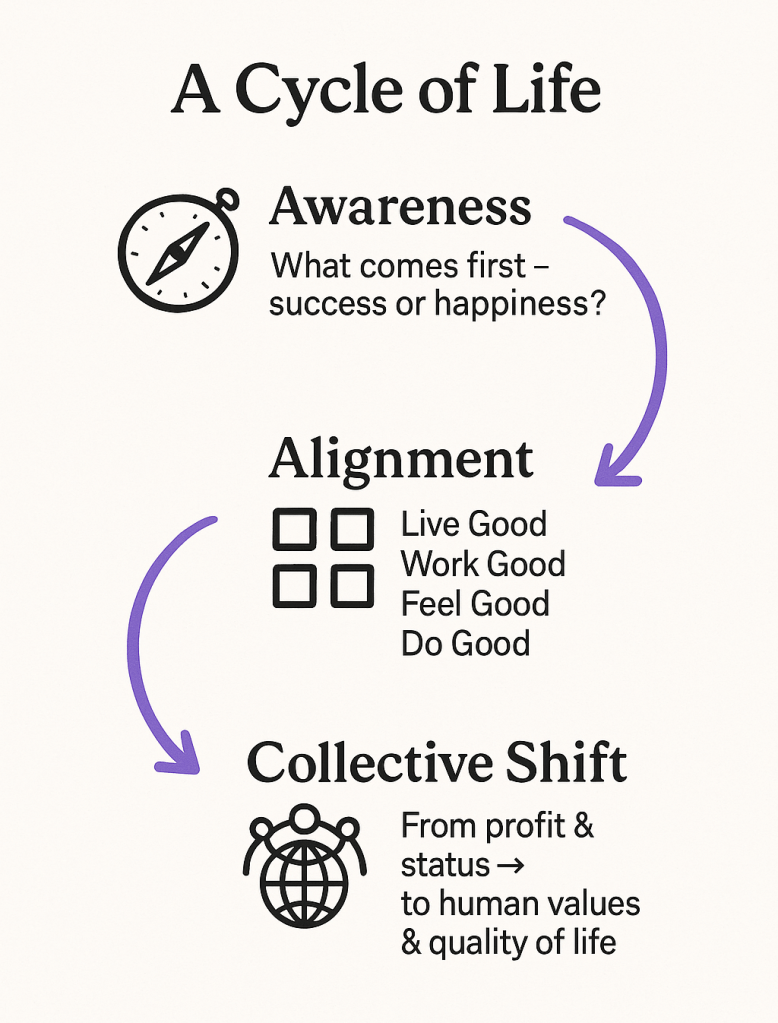
A cycle of life

Awareness is the first step.

Every journey needs a compass. For the QOL Tour, it begins with a simple but radical question:

What comes first – success or happiness?

This question cracks open the illusion that one day, if we just push hard enough, success will bring happiness. Instead, it invites us to notice the gap – between what we have and what we actually long for.

Awareness is about VALUES. It’s remembering what matters most, and using that as our compass. (see this blogpost about Values)

From awareness, the path moves into:

Daily alignment.

And here, the journey is not about grand revolutions or 10-point plans. It is about small, human steps in our daily lives:

  • To live good, shaping our homes and communities in ways that feel true.
  • To work good, bringing purpose and balance back into how we earn and create.
  • To feel good, taking care of our health, energy, and spirit.
  • To do good, contributing to something bigger than ourselves.

These four pillars are HABITS of alignment. They are proof that change doesn’t begin in theory — it begins in the everyday choices we make.

And when enough people walk this path, something greater emerges:

A collective shift.

This is where CULTURE changes. Success is no longer measured only by profit or status, but by the quality of life we create and share. It is the beginning of a social economy based on human values.

the role of the QOL Tour

The QOL Tour is my way of bringing this cycle of life into practice.

It’s a living documentary – listening, observing, capturing, and talking with people in different cities.

Not about perfect answers or polished stories, but about showing life as it is: raw, unfiltered, human.

In each city, the Tour doesn’t just collect stories – it leaves something behind:

+ A reflection for citizens: proof that their voices are heard, seen, and part of something bigger.

+ A spark for businesses: the challenge to ask how their work truly contributes to quality of life.

+ Insights for governments: reminders that leadership must start with people, not just numbers.

The Tour is not about escape, but about return. It is about walking the path together, step by step, from awareness to daily alignment, toward collective renewal.

The deeper aim

The original Hippie Trail was a road eastward, chasing enlightenment.

This new Hippie Trail is a road inward – and then outward again.

It is a cycle of awareness, alignment, and collective change.

It is a reminder that success is no longer defined by what we own, but by the quality of life we share.

That is the deeper journey of the QOL Tour.

Not a path to get away from the world, but a path to finally live in it – fully, humanly, and together.

Categories
Business Hippie Way

happiness & success survey – then

What 139 entrepreneurs shared in 2018 still echoes today

In 2018, I conducted a study that turned out to be more than research – it became a wake-up call.

I had been asking a question in my coaching sessions for years:

What comes first – happiness or success?

Some people answered quickly: “Success, of course.” Others hesitated. “Well… depends what you mean by happiness.”

But when I invited 139 entrepreneurs to explore that question more deeply, the answers revealed something powerful:

Most people were chasing one and sacrificing the other.

That was the starting point for the Happy Business You research.
What people shared back then still shapes everything I do today, and it became the seed of what would later grow into the Quality of Life Concept & Tour.

What the survey revealed

This wasn’t a casual online quiz. It was a full survey built on respected frameworks: Maslow’s needs, McClelland’s motivation theory, EQ, the Business Model You, and even the nine domains of Gross National Happiness. The survey explored:

  • What makes people feel truly happy in their business-life
  • How they define success – on their own terms
  • What happens when the two don’t match
  • And whether change actually feels possible

The answers came from 139 entrepreneurs, across sectors and stages of life.

The real story behind “Success”

When asked whether they felt successful as entrepreneurs, many said yes – but not without hesitation. Success was often linked to external results (revenue, growth, team performance), yet…

“Even with results, I’m not always in balance.”

Over half of participants admitted that their company’s performance strongly influenced their personal sense of happiness – for better or worse. So while success felt measurable, happiness felt more fragile.

The deeper motivators

When asked what truly made them happy, 76% of respondents said:

“It’s important that we do something good and contribute to society.”

This was more than window dressing, it was a core value. People wanted their business to mean something. Not just in terms of impact, but in how it aligned with their personal values.

Another common response:

“I feel happiest when I grow personally, not just professionally.”

This distinction between doing well and feeling well became one of the most valuable insights I’ve carried with me since.

Identity and misalignment

A majority identified strongly as entrepreneurs:

“It’s in my blood.”

But many also admitted feeling tired, out of rhythm, or disconnected from their original purpose. They were still “playing the part,” but not always living the truth of why they started.

Desire for change

Most participants said they believed in growth, and wanted it, not just in revenue, but in their own life experience. They were open to change, but often stuck in the structures they’d built for themselves.

“I know what I want to change. I just don’t know how.”

This was the contradiction I saw again and again: People deeply wanted alignment – but didn’t feel free to pursue it.

Why it still matters today

Looking back, this study wasn’t just about the answers. It was about what people felt but rarely said out loud. It showed that even back then, people were beginning to question:

  • What is success really costing me?
  • What does “enough” feel like?
  • Am I still building the life I want?

And that’s why, years later, I started the Quality of Life & Tour. Because the need to rethink success and realign with what matters has only grown louder.

From survey to movement

This research may be from 2018, but its message is timeless:

  • Success without happiness is hollow
  • Purpose matters more than ever
  • Entrepreneurs are people first
  • And real change begins with honest reflection

So soon, when I travel from city to city – listening, reflecting, and gathering stories – I’m not just documenting a tour. I’m continuing a conversation that started with 139 brave responses.

Want to reflect on your own path?

You’re invited. Just two ways to take your next step:

Visit the QOL Tour page – see where the journey is going next and what stories we’re gathering across the world.
Try the Soulprint Compass – upload 3 images that feel like “you” and receive a visual mirror + a soulful suggestion on where to begin realigning your life.

Because maybe it’s not about chasing more. Maybe it’s about remembering what matters.