Categories
Business Hippie Way

Quality of Life Atlas – December

This Quality of Life Atlas reflects how daily life is currently spoken about and experienced across six cities. It is based on recurring human signals observed in Lisbon, Barcelona, Paris, Bologna, Ibiza, and Dubai. (our QOL tour cities)

The Atlas does not rank cities, explain causes, or propose solutions. Instead, it listens for tone, repetition, and quiet tension in how people live, work, stay healthy, and contribute.

It is not a complete map, but a partial lens. Its value lies in what repeats across places, but the shared patterns that surface in everyday life.

The four pillars – Live, Work, Health, and Do Good – reflect how people naturally speak about their lives. Together, they offer a human reading of quality of life beyond single metrics or themes.


The global human weather

The dominant human tone in December was calm endurance.

People are not describing crisis. They are describing holding patterns.

Across cities, language carries appreciation alongside caution. Life is often described as “good,” but rarely without a condition attached. Belonging feels real, yet provisional. Comfort exists, but it is carefully managed.

There is little urgency in how people speak. There is also little excess capacity.

This is not collapse. It is careful living.


Live Good

Home as a phase, not a destination

Across cities, living conditions are increasingly described with time-based qualifiers: “for now,” “while it works,” “as long as it’s manageable.”

Affordability is often referenced in the past tense. Even when people enjoy where they live, there is an underlying awareness that conditions may not last. The language is not dramatic. It is practical and adjusted.

Home is not rejected. It is held lightly.


Work Good

Work as support, not identity

Work is rarely described as a future narrative. Instead, people speak of positioning: “good enough,” “works for my life,” “not a long-term engine.”

Patchwork careers and hybrid identities feel normalized. Mobility is often implicit. Work is chosen to sustain quality of life, not to define success.

There is little ambition language. There is also little resentment.


Health

Energy, pace, and recovery

Across cities, people speak more about energy, rhythm, and recovery than about happiness or performance.

Daily language reflects self-regulation: routines are protected, pace is adjusted, exposure is limited. Fatigue is normalized rather than dramatized. Comfort is prioritized over intensity.

The dominant signal is not illness. It is low reserve.

People are managing health quietly, as part of everyday life.


Do Good

Contribution becoming smaller and closer

Large outward ambition is mostly absent from lived language. Instead, people describe caring locally, maintaining close circles, and staying functional within their immediate environment.

The desire to contribute hasn’t disappeared.
It has narrowed.

Doing good has become quieter, more personal, and less performative.


City echoes

  • Lisbon — lifestyle warmth paired with provisional belonging and financial calculation
  • Barcelona — cultural vibrancy alongside sharpening housing pressure in daily language
  • Paris — pride mixed with endurance; life framed as maintenance rather than momentum
  • Ibiza — beauty and community coexisting with seasonal survival rhythms
  • Bologna — stable quality of life with muted social energy and mild ambivalence
  • Dubai — opportunity framed conditionally; life described as optimisation rather than permanence

What settled during December

One shift stood out across cities:

Housing language moved from concern to inevitability.

People no longer debate whether housing is difficult. They speak as if it simply is. The emotional charge has softened, replaced by acceptance and adaptation.

When tension stops being discussed and starts being managed, it has entered daily life.


Closing reflection

This Atlas does not argue for change.
It reflects what people are quietly carrying.

Across cities, quality of life in December was less about progress and more about keeping life workable.

This is not pessimism.
It is attentiveness.

How this Atlas is formed

The Quality of Life Atlas is based on a continuous reading of public human signals. This includes resident and expat discourse, surveys, public reporting, local media, and everyday language across cities.

The focus is not on events, metrics, or individual opinions, but on recurring patterns in how people describe daily life. The Atlas listens for tone, repetition, and quiet tension rather than headlines or trends.

Subscribe

This is a monthly update. If you’d like to follow future editions of the Quality of Life Atlas, you can subscribe here.

Categories
Business Hippie Way

We search for proof, not truth

I was sitting on a terrace, coffee getting cold in front of me, watching people pass by.

A man at the next table kept refreshing his inbox. Across the street, someone walked while talking into their phone, pausing as if the air itself was listening. At another table, a couple sat together, both scrolling, barely speaking.

Nothing dramatic. Just a normal day. Still, something felt familiar.

In conversations about life or work, people rarely asked “Does this feel right?”

They asked “Is there evidence?”

Research, numbers, stories of others who had tried and succeeded. Proof felt safer than truth.

Where shared stories used to hold us

Not so long ago, people leaned on something different. Shared meaning. Traditions. Tribes. Rituals that gave shape to life’s bigger questions.

I reflected on this in an earlier piece about how shared anchors have faded – The Decline of Religion: A New Search for Meaning – and how that leaves a quiet absence or even emptiness inside us.

In another piece, The Rise of Societal Refugees, I named what often follows: not aimlessness, but the feeling of being a stranger inside your own life – and moving to other places as a result.

People work, perform, connect. Yet something feels slightly off, like living someone else’s rhythm.

When tension turns inward

The first signs are small. A tiredness that lingers. A busyness that feels strangely empty. The sense of keeping up while losing touch with yourself.

When that happens, the advice is usually practical.

Work on yourself.
Improve your mindset.
Find a better routine.

So people try. And while trying, they look for reassurance. Proof that this discomfort is normal. Proof that the effort will pay off – eventually.

Proof helps them carry on. It “explains” unease. It gives language to a feeling. But some questions don’t show up in data. They arise in quiet moments. On terraces. On evening walks home. Late at night.

Questions about pace. Questions about meaning. Questions about whether this way of living still fits. Those questions don’t ask for proof. They ask for attention.

Maybe the shift isn’t about finding better answers. Maybe it’s about listening more closely.

And slowly learning the difference between what works on paper
and what works in a human life.

And maybe that’s where quality of life quietly begins – not in what we can prove, but in what we’re finally willing to notice.

Categories
Business Hippie Way

Is Quality of Life the next human right?

We talk about human rights as if they’re written in stone – the right to life, freedom, safety, and dignity. But in a world where millions survive without truly living, maybe it’s time to add one more:

the right to quality of life

Because what good is the right to life if life itself loses quality?

From survival to thriving

The Universal Declaration of Human Rights, written in 1948, was born from a world trying to survive war. Today, we face a different kind of struggle – not just to stay alive, but to live well.

We have more comfort than any generation before us, yet less peace of mind. We work harder, connect faster, and achieve more – but often feel emptier. The right to survive is no longer enough.

we need the right to thrive

What quality of life really means

Quality of life isn’t about luxury or convenience. It’s about balance, belonging, purpose, and peace. It’s having time to breathe, space to create, and a sense of meaning in what we do.

It’s not a single right – it’s the result when all human rights are truly lived. When people have fair work, good health, a home, community, and a chance to contribute, quality of life becomes the living proof that society is working.

So yes – in essence, quality of life is already a human right. We just forgot to treat it as one.

Who protects it?

That’s the challenge. Governments measure economies, not happiness. Companies measure performance, not presence. And individuals, caught in the middle, measure themselves against expectations that have nothing to do with wellbeing.

Quality of life can’t be managed by one sector, it must be co-stewarded.

  • Governments can set fair conditions.
  • Businesses can create humane workplaces.
  • Communities can rebuild connection and care.
  • Individuals can live by values instead of algorithms.

Each carries a piece of responsibility for the whole. Because life itself is the shared project we’re all managing.

A new social contract

Maybe this is where the next evolution of human rights begins – not in more laws, but in new awareness. The right to quality of life means:

  • the right to time, not just work.
  • the right to purpose, not just pay.
  • the right to connection, not just communication.
  • the right to peace, not just productivity.

That shift won’t come from politics alone. It starts in how we lead, work, and live – day by day, choice by choice.

The Business Hippie Way

At the Business Hippie Club, we believe leadership is not just about managing business — it’s about safeguarding life. If success comes at the cost of wellbeing, it’s not success.

Quality of life is the new success
– and perhaps, the next human right

Because when people live well, they don’t just survive – they make the world better by how they live.

Any comments? Please do!

Categories
Business Hippie Way

Do crises make us more or less human?

What happens to our humanity when the world feels uncertain – and how crisis can quietly restore our sense of connection, purpose, and care.

We live in a world that feels like a continuous breaking point – socially, economically, environmentally. Yet every crisis also carries a strange gift: the chance to rediscover what makes us human.

Through the lens of quality of life, this reflection explores how disruption can both test and strengthen our shared humanity – and why our response may matter more than the event itself.

Every day brings a new crisis

War, inequality, climate change, disconnection – all competing for our attention and compassion. It’s easy to feel unsettled. But crisis isn’t only about what breaks; it’s also about what wakes us. When the familiar falls away, what truly matters steps forward.

In the first year of the pandemic, global anxiety and depression rose by 25 %, and more than a billion people now live with mental-health challenges.

At the same time, researchers observed something remarkable: catastrophe compassion – a surge of empathy and solidarity. When things fall apart, people reconnect. Neighbours talk again. Communities reorganize. Purpose returns.

And then there’s the invisible layer – the climate syndrome. Nearly six in ten young people feel deep eco-anxiety: a mix of grief and care for a planet in distress. Yet even that shows our capacity to feel / proof that humanity is still alive and responsive.

The Quality of Life perspective

+ Crises shake our conditions – health, stability, safety.
+ They challenge our experiences – how we relate and find meaning.
+ But they can also clarify our values – what we stand for when comfort fades.

Quality of life isn’t defined by avoiding difficulty. It’s defined by how we stay human through it. When we keep caring, connecting, and creating – even in uncertainty – life regains its quality.

So maybe the question isn’t how bad things are, but how awake we choose to be within them. Because every crisis is a mirror. And sometimes, in its reflection, we rediscover the best parts of ourselves.

Reflect

When was the last time a challenge brought out something more human* in you – not less? Share your reflection or join a local CoffeeTalk during the Quality of Life Tour to keep the conversation going.

Because real insight begins in dialogue -and that’s where a better quality of life takes shape.

Categories
Business Hippie Way

from enlightenment to alignment

Everywhere I go, I hear the same quiet confession:

“I’m tired of this system. It doesn’t work for me anymore”

+ It comes from entrepreneurs who, despite their success, admit they feel empty inside.

+ From citizens who can no longer afford housing in the places they grew up.

+ From leaders who whisper, behind polished walls, that even when we “win,” something human gets lost on the way.

The cracks in our economy are visible. Growth without balance is no longer sustainable. Profit and status, the markers of “modern” success, ring hollow when daily life feels exhausting and disconnected.

And yet, beyond the cracks, I sense something else: a hunger. People are restless, not just for more money or comfort, but for meaning. For a life that feels aligned with who they are. See my in-depth article: The decline of religion: a new search for meaning

Looking back – and looking forward

Fifty years ago, thousands of young people left Europe behind and followed the Hippie Trail eastward, chasing enlightenment. They were disillusioned by their societies, distrustful of old systems, and hungry for truth. Their journey was outward, across borders and landscapes, searching for something transcendent.

Today, the search is still alive. But it’s no longer about escape.

It’s about alignment.

Not with gurus or distant ideals, but with ourselves, our values, and the way we live each day. Alignment between the inside and the outside. Between what we feel and what we do.

That is the deeper aim of the QOL Tour.

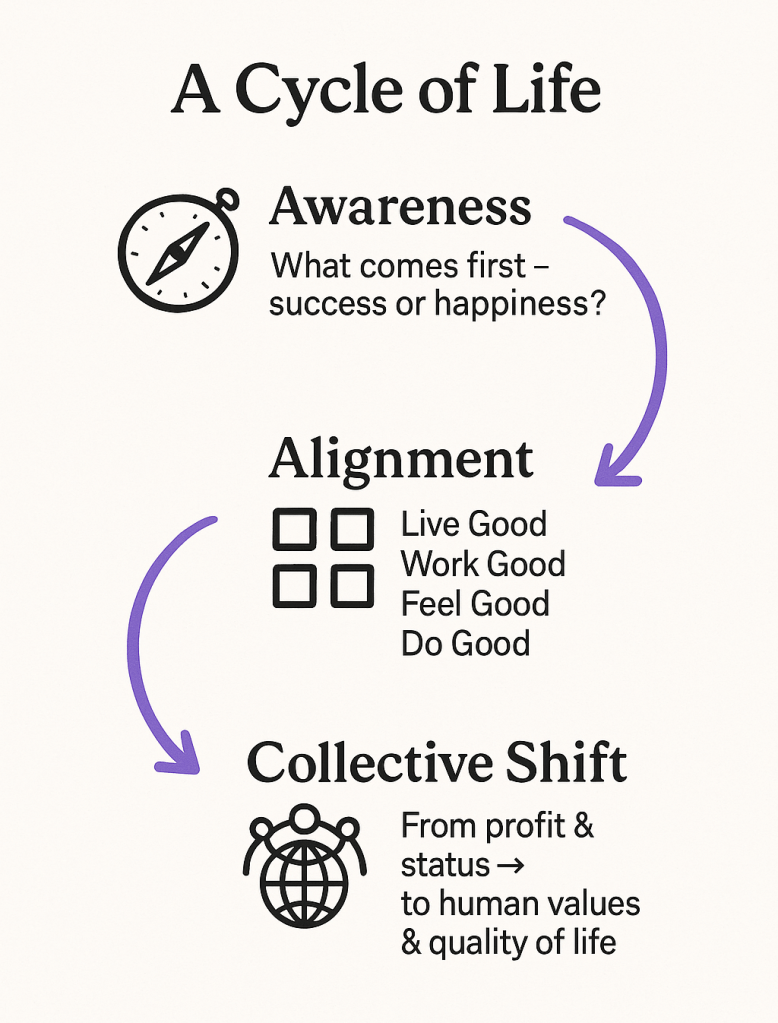
A cycle of life

Awareness is the first step.

Every journey needs a compass. For the QOL Tour, it begins with a simple but radical question:

What comes first – success or happiness?

This question cracks open the illusion that one day, if we just push hard enough, success will bring happiness. Instead, it invites us to notice the gap – between what we have and what we actually long for.

Awareness is about VALUES. It’s remembering what matters most, and using that as our compass. (see this blogpost about Values)

From awareness, the path moves into:

Daily alignment.

And here, the journey is not about grand revolutions or 10-point plans. It is about small, human steps in our daily lives:

  • To live good, shaping our homes and communities in ways that feel true.
  • To work good, bringing purpose and balance back into how we earn and create.
  • To feel good, taking care of our health, energy, and spirit.
  • To do good, contributing to something bigger than ourselves.

These four pillars are HABITS of alignment. They are proof that change doesn’t begin in theory — it begins in the everyday choices we make.

And when enough people walk this path, something greater emerges:

A collective shift.

This is where CULTURE changes. Success is no longer measured only by profit or status, but by the quality of life we create and share. It is the beginning of a social economy based on human values.

the role of the QOL Tour

The QOL Tour is my way of bringing this cycle of life into practice.

It’s a living documentary – listening, observing, capturing, and talking with people in different cities.

Not about perfect answers or polished stories, but about showing life as it is: raw, unfiltered, human.

In each city, the Tour doesn’t just collect stories – it leaves something behind:

+ A reflection for citizens: proof that their voices are heard, seen, and part of something bigger.

+ A spark for businesses: the challenge to ask how their work truly contributes to quality of life.

+ Insights for governments: reminders that leadership must start with people, not just numbers.

The Tour is not about escape, but about return. It is about walking the path together, step by step, from awareness to daily alignment, toward collective renewal.

The deeper aim

The original Hippie Trail was a road eastward, chasing enlightenment.

This new Hippie Trail is a road inward – and then outward again.

It is a cycle of awareness, alignment, and collective change.

It is a reminder that success is no longer defined by what we own, but by the quality of life we share.

That is the deeper journey of the QOL Tour.

Not a path to get away from the world, but a path to finally live in it – fully, humanly, and together.

Categories
Business Hippie Way

happiness & success survey – then

What 139 entrepreneurs shared in 2018 still echoes today

In 2018, I conducted a study that turned out to be more than research – it became a wake-up call.

I had been asking a question in my coaching sessions for years:

What comes first – happiness or success?

Some people answered quickly: “Success, of course.” Others hesitated. “Well… depends what you mean by happiness.”

But when I invited 139 entrepreneurs to explore that question more deeply, the answers revealed something powerful:

Most people were chasing one and sacrificing the other.

That was the starting point for the Happy Business You research.
What people shared back then still shapes everything I do today, and it became the seed of what would later grow into the Quality of Life Concept & Tour.

What the survey revealed

This wasn’t a casual online quiz. It was a full survey built on respected frameworks: Maslow’s needs, McClelland’s motivation theory, EQ, the Business Model You, and even the nine domains of Gross National Happiness. The survey explored:

  • What makes people feel truly happy in their business-life
  • How they define success – on their own terms
  • What happens when the two don’t match
  • And whether change actually feels possible

The answers came from 139 entrepreneurs, across sectors and stages of life.

The real story behind “Success”

When asked whether they felt successful as entrepreneurs, many said yes – but not without hesitation. Success was often linked to external results (revenue, growth, team performance), yet…

“Even with results, I’m not always in balance.”

Over half of participants admitted that their company’s performance strongly influenced their personal sense of happiness – for better or worse. So while success felt measurable, happiness felt more fragile.

The deeper motivators

When asked what truly made them happy, 76% of respondents said:

“It’s important that we do something good and contribute to society.”

This was more than window dressing, it was a core value. People wanted their business to mean something. Not just in terms of impact, but in how it aligned with their personal values.

Another common response:

“I feel happiest when I grow personally, not just professionally.”

This distinction between doing well and feeling well became one of the most valuable insights I’ve carried with me since.

Identity and misalignment

A majority identified strongly as entrepreneurs:

“It’s in my blood.”

But many also admitted feeling tired, out of rhythm, or disconnected from their original purpose. They were still “playing the part,” but not always living the truth of why they started.

Desire for change

Most participants said they believed in growth, and wanted it, not just in revenue, but in their own life experience. They were open to change, but often stuck in the structures they’d built for themselves.

“I know what I want to change. I just don’t know how.”

This was the contradiction I saw again and again: People deeply wanted alignment – but didn’t feel free to pursue it.

Why it still matters today

Looking back, this study wasn’t just about the answers. It was about what people felt but rarely said out loud. It showed that even back then, people were beginning to question:

  • What is success really costing me?
  • What does “enough” feel like?
  • Am I still building the life I want?

And that’s why, years later, I started the Quality of Life & Tour. Because the need to rethink success and realign with what matters has only grown louder.

From survey to movement

This research may be from 2018, but its message is timeless:

  • Success without happiness is hollow
  • Purpose matters more than ever
  • Entrepreneurs are people first
  • And real change begins with honest reflection

So soon, when I travel from city to city – listening, reflecting, and gathering stories – I’m not just documenting a tour. I’m continuing a conversation that started with 139 brave responses.

Want to reflect on your own path?

You’re invited. Just two ways to take your next step:

Visit the QOL Tour page – see where the journey is going next and what stories we’re gathering across the world.
Try the Soulprint Compass – upload 3 images that feel like “you” and receive a visual mirror + a soulful suggestion on where to begin realigning your life.

Because maybe it’s not about chasing more. Maybe it’s about remembering what matters.

Categories
Business Hippie Way

choose a lifestyle – or it chooses you

Let’s be honest. Most of us didn’t choose our lifestyle – it just sort of… happened. You picked a job. Said yes to the next thing. Took on responsibilities. And before you knew it, your days had a rhythm. Your weeks had a shape. Your life… had (sort of) a lifestyle.

But did you choose it? Or did it just grow around you, until one day, it became your ‘normal’?

The quiet danger of drifting

If you don’t choose how to live, the world chooses for you. And let’s be honest – its version of “success” doesn’t always feel like a life well-lived.

We end up chasing success, but feeling flat. Working hard, but wondering what it’s all for. Living… but not really alive.

So what if you chose?

What if – starting now – you chose how you want to live? Not in a dramatic, drop-everything way. But in small, steady shifts.

  • Saying no when it doesn’t feel aligned
  • Creating space for what fills you up
  • Working in a way that serves your life – not the other way around
  • Remembering what matters before it becomes a crisis

This is what the Business Hippie Way is about

Not a system. Not a trend. Just a quiet, powerful decision to live your own way – from the inside out.

To trade pressure for presence. Hustle for honesty.
Success for something that actually feels good to wake up to.

I didn’t always live like this. But choosing this path changed everything for me. It’s not perfect. It’s personal. And it’s real.

A gentle reminder

You’re already living some kind of lifestyle. The only question is: is it the one you want? Choose a lifestyle – or it chooses you.

EXPLORE THE BUSINESS HIPPIE WAY

Categories
Business Hippie Way

The wisdom economy

Why experience is the most undervalued asset in business today

In a world obsessed with innovation, there’s one thing scarcer than AI engineers, more precious than seed funding, and more powerful than any growth hack:

Lived experience.

Not data.
Not degrees.

But the kind of wisdom you can only earn by screwing up, showing up, and staying the course, over years, not quarters.

We call this the Wisdom Economy.

And right now, it’s undervalued, underused, and desperately needed.

Forget the experience economy. This is deeper.

You’ve probably heard of the Experience Economy, where people value moments and memories over material things.

But here’s a twist: What if the next evolution is about valuing the people behind the experience?

Not just creators and consumers, but the seasoned humans who’ve walked the road, fallen into holes, and found wiser ways forward.

That’s the Wisdom Economy.

It’s not about status or age.
It’s about depth. About people who’ve turned pain into insight, pressure into clarity, and business into something more human.

Here’s the disruption: we’re throwing away the real competitive advantage.

Modern business idolizes youth, speed, and novelty. But ask any founder post-burnout, or any startup that scaled too fast: What you really need is wisdom.

Wisdom is what helps you pause before the wrong hire.
It’s what saves you from chasing the wrong metric.
It’s the calm in chaos that turns a crisis into a turning point.

And yet, most organizations don’t hire for it.
They don’t know how to measure it.
And they certainly don’t design cultures that cultivate it.

A call to leaders: stop hiring for credentials, start listening for lived truth.

What if your next strategic hire wasn’t a young hustler with a deck full of buzzwords, but a 64-year-old former CEO who knows how to lead humans, not just systems?

What if mentorship wasn’t a side program, but the core engine of your culture?

What if your brand wasn’t just fast and clever, but wise, seasoned, and built to last?

This isn’t about nostalgia. It’s about survival. Because businesses that don’t tap into wisdom are building towers on sand.

Intergenerational collaboration: not just nice to have, critical to thrive.

We don’t need more echo chambers of Gen Z speed or Boomer certainty. We need spaces where urgency meets depth, and fresh ideas meet timeless insight.

In the Business Hippie Club, we call it circular creativity, where ideas, insights, and experience aren’t just shared, they’re reimagined, reused, and returned to the circle with new life.

It’s wisdom on the move. And who knows… maybe it’s the start of a new circular movement. 😉

It’s where a 28-year-old purpose-driven founder sits with a 64-year-old life-tested strategist, and something magic happens.

Not mentorship.
Not coaching.
But mutual activation.

The future belongs to those who don’t just innovate but integrate.

The wisdom economy lives where people come together to live wisely

This isn’t just a future concept. It’s already emerging, in places where values drive decisions, and where lived experience is shaping how we work and relate.

One example is our concept of Nomad Villages: age-friendly micro-communities built for conscious entrepreneurs, digital nomads, and remote leaders who want more than just a beautiful place to work.

They want meaning. Belonging. A life that makes sense from the inside out. They are living proof that the wisdom economy doesn’t have to be theorized, it can be lived.

In these spaces, the boundaries between life, work, and aging blur into something more human.

More real.
More whole.

The question isn’t when the wisdom economy will come.
It’s where you’ll choose to build, live and belong.

The takeaway: experience is your most sustainable business model.

Let’s stop pretending wisdom is a “nice extra.”
It’s your true north in a world full of noise.

So here’s the challenge:

  • Create space for wisdom in your boardrooms, brainstorms, and business models.
  • Invite voices that speak in lived truth, not just trends.
  • Build the Wisdom Economy, not by talking about it, but by practicing it.

Because what the world needs now isn’t more information.

It needs integration.
It needs leaders who’ve lived.

Want to build a business that integrates wisdom, experience, and impact?

That’s what we do at the Business Hippie Club. Because insight without action is just another quote on the wall.

Let’s make it real.

TALK TO ME (I’m 64…)

Categories
Business Hippie Way

The Age of Wisdom

Rethinking aging as a gift

Aging is often framed as a decline, but what if we saw it as a renaissance? By 2050, one in six people globally will be over 65. In Japan, more adult diapers are sold than baby diapers. Let that sink in. The world is shifting, and yet our outdated views on aging haven’t caught up. The real question isn’t just how we live longer—but how we live better.

This is where the Business Hippie Club’s vision comes in: redesigning societal systems beyond profit – toward quality of life for all generations. Aging isn’t a burden; it’s a superpower, one that economies, communities, and cultures can harness for innovation, wisdom, and yes, even fun.

The freedom to redefine aging

Forget the rocking chair cliché. Many seniors today are proving that ‘retirement’ is just another word for reinvention, whether it’s launching a startup, hiking the Camino de Santiago, or learning to DJ at 70. The challenge? Making sure societies don’t force older adults into passive roles but instead create environments where they can thrive, contribute, and shake things up.

Aging is the VIP pass to the wisdom economy, a world where lived experience becomes the most valuable currency. But are we designing a society that lets older generations cash in?

A new economic landscape

Traditional pension models and elder care systems are under strain, but let’s flip the narrative: this isn’t a crisis – it’s an economic goldmine.

  • Knowledge Economy: Older adults bring decades of expertise, yet we still make them retire at the peak of their wisdom. How does that make sense?
  • Silver Economy Boom: The aging population is driving a $15 trillion global market. Industries from health tech to travel are shifting gears to serve an audience that actually has money to spend.
  • Intergenerational Collaboration: Some of the most forward-thinking businesses are now pairing younger entrepreneurs with senior mentors, combining fresh ideas with hard-earned experience.

Aging populations aren’t an economic drag; they’re society’s most underutilized asset. It’s time to rethink how we engage them.

Quality of life over lifespan

We’ve cracked the code on longevity, but we still haven’t nailed living well. If extra years just mean more time stuck in traffic, staring at screens, or being isolated, what’s the point?

Here’s what really matters:

  • Staying Physically Active: From senior parkour groups in London to 80-year-olds running marathons, movement is medicine.
  • Prioritizing Mental Health: Loneliness is as bad for you as smoking 15 cigarettes a day, let’s treat it like the public health crisis it is.
  • Fostering Purpose: Communities that integrate older adults into social life, whether through volunteering, creative projects, or mentoring – see higher happiness and lower healthcare costs.

Redesigning communities for aging well

Cities and communities must evolve fast to support an aging population that wants to live, not just exist. Some of the best solutions out there?

  • Age-Friendly Urban Design: Think walkable cities, slow streets, and intergenerational public spaces.
  • Micro-Housing & Cohousing: Because not everyone dreams of a retirement home in the suburbs. Flexible, shared-living options promote connection and independence.
  • Nomad Villages & Micro-Communities: Imagine senior co-living spaces where knowledge, stories, and a well-aged bottle of wine are shared in equal measure. See the disruptive concept of the Business Hippie Club: nomad villages | age-friendly micro-communities
  • Healthcare Innovations: AI-driven eldercare, smart homes that adjust to aging needs, and preventive health tech that keeps people thriving, not just surviving.

Changing the narrative

It’s time to rewrite the story of aging. The world has an obsession with youth, but here’s a reality check: some of the most creative, powerful, and fulfilled people in history did their best work in later years.

  • Vera Wang started designing dresses at 40.
  • Colonel Sanders launched KFC at 65.
  • Michelangelo was still sculpting at 89.
  • And let’s not forget that Mick Jagger is still rocking stadiums at 80.

If we stopped seeing aging as decline and started seeing it as expansion, imagine what we could unlock.

The call to action

Aging isn’t something to fear, it’s an invitation to live more fully, with greater intention. But making this a reality means rethinking policies, cities, and mindsets. It’s up to individuals, communities, businesses, and policymakers to stop sleepwalking and start building a future where aging is an asset, not an afterthought.

Let’s embrace it, the business hippie way, where quality of life is the measure of progress. And if we do it right, we’ll all look forward to getting older.

Peace, Love & Happiness!

Categories
Business Hippie Way

the wisdom gap in business

I’ve spent decades navigating the world of business – sometimes with great success, sometimes with spectacular failures. If there’s one lesson I’ve learned the hard way, it’s this: wisdom always outweighs raw knowledge. Yet, in today’s fast-moving world, businesses often mistake having more information for having better judgment.

We live in an era of instant data. AI tools generate insights in seconds, trends shift overnight, and decisions are made at lightning speed. But where is the space for wisdom?

Think about a seasoned craftsman who has spent decades mastering his art. He doesn’t just follow instructions – he intuitively knows what works and why. Now, compare that to a business leader relying solely on analytics, chasing trends, and making decisions without experience.
The difference? One builds something that lasts, while the other is always playing catch-up, like a hamster on a corporate treadmill. And trust me, I’ve been that hamster before.

Why businesses ignore wisdom

Many businesses assume more data means better decisions. But real leadership isn’t about certainty – it’s about making decisions despite uncertainty. I’ve seen leaders drown in spreadsheets, trying to analyze their way to the perfect choice, only to realize that wisdom – the gut feeling that comes from experience – was what they really needed all along.

Speed is another enemy of wisdom. Companies want results now, so they rush into actions that look good short-term but crumble over time. Wisdom takes patience – like the difference between a microwaved meal and a slow-cooked feast. One is faster, but the other is far more satisfying. And believe me, I’ve experienced that slow-cooked business decisions always taste better in the end.

Then there’s the obsession with trends. Businesses chase what’s new, afraid to be left behind. (Business FOMO) But wisdom isn’t trendy – it’s timeless. Trends come and go, like questionable fashion choices (yes, I’ve made a few of those too) but wisdom? That’s the classic leather jacket that never goes out of style.

The cost of ignoring wisdom

Ignoring wisdom comes with a price. I’ve worked with companies that were so focused on immediate success that they burned out their teams chasing numbers without real purpose. Sure, they saw short-term wins, but long-term stability? Nowhere in sight.

Customers and employees today crave authenticity. Businesses that lack wisdom quickly lose trust because people can spot the difference between those who operate with true insight and those who are just chasing the next big thing. And let’s be honest – nobody wants to work for or buy from a company that operates like a headless chicken.

How wisdom gives businesses an edge

So, how can businesses integrate wisdom into their approach?

First, Zoom Out And See The Bigger Picture. Wisdom isn’t found in spreadsheets – it’s found in human experience, in understanding long-term impact rather than just reacting to immediate trends.

Second, Use AI As A Tool, Not A Crutch. AI can analyze data, but it lacks intuition. The best leaders use it to enhance their decision-making, not replace it. AI is like a GPS – it can guide you, but if you follow it blindly, you might still end up somewhere you don’t want to be (I’ve done that too, by the way).

Third, Seek Out Those Who’ve Walked The Path. The best insights come from those who have built, failed, and rebuilt. I’ve been through the highs and lows, and I can tell you – if wisdom were a stock, it would be the ultimate blue-chip investment.

Fourth, Prioritize Purpose Over Profit. Businesses that stand for something bigger attract loyal customers and engaged employees. Ironically, when companies focus on meaningful impact, profits tend to follow. It’s one of those beautiful contradictions in life.

Finally, Slow Down To Speed Up. In a world addicted to rapid results, those who take the time to think deeply and act intentionally will always outlast those who rush blindly.

The future belongs to the wise

The businesses that last won’t be the ones with the most data. They’ll be the ones that know how to turn knowledge into wisdom and use it to create something meaningful.

AI is powerful, but it’s just a tool. Real success belongs to those who know when to use it and when to trust human wisdom.

So, here’s my challenge to you:
Are you just collecting knowledge, or are you ready to embrace wisdom?

If you’re looking to build a business that lasts, I’d love to help. Let’s rethink, redesign, and build a wiser way forward together.